One Agent Per User Doesn't Scale: What Anthropic's "Worse Together" Study Reveals About Multi-Agent Systems
When each user gets their own AI agent and the agents share a budget, a CI queue or a cart, group outcomes drop. What Anthropic's Worse Together study measured, why communication is not coordination, and how to build the leads, checkout guards and acknowledgements that recovered most of the loss.
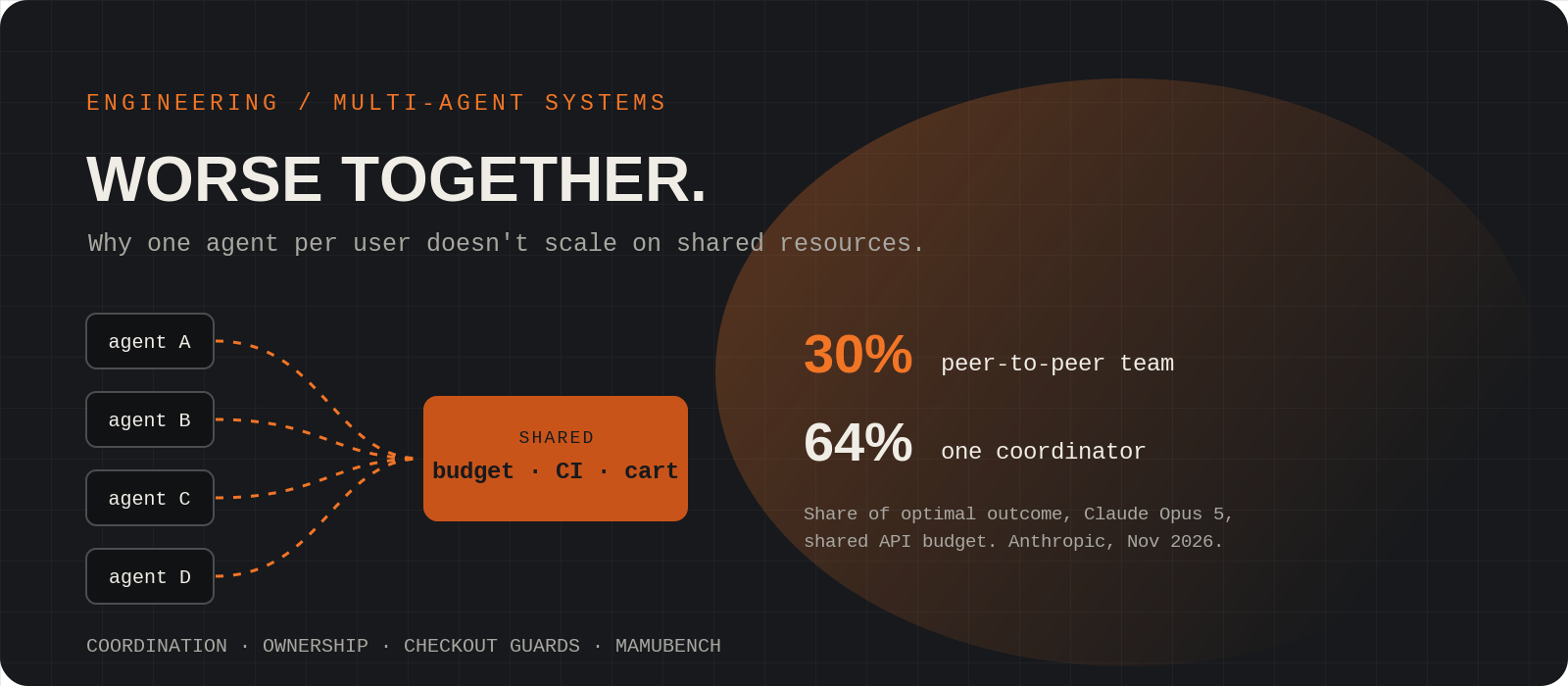
Does giving every user their own AI agent scale? Not when the agents share something scarce. In Anthropic's Worse Together study, published on 11 November 2026, teams of per-user agents that could message each other produced worse group outcomes than a single agent coordinating all the users, in every one of the four environments tested, for both Claude models. The gap ran from about 10 to 45 percentage points. The failures were specific: agents acted too late, ordered work against its value, overrode other users' requests, made claims about other people that nobody had made, and committed shared orders before reading the message that would have changed them. The useful part is what fixed it. A team lead with real authority, a few explicit operating rules and a platform guard that refuses checkout while messages are unread each recovered much of the lost performance. This deep dive walks through what was tested, what broke, and how to build those safeguards into your own multi-agent system.
System requirements
Who this is for
Developers building multi-user or multi-agent systems
Anyone whose agents act for different people on something shared: a compute budget, a CI runner, a calendar, a cart, a repository. Steps 01 to 06 explain the findings; 07 to 12 are the build and test work.
Primary source
Paliskara et al., "Worse Together: How Performance Breaks Down in Multi-User Multi-Agent Teams"
Anthropic Alignment Science blog post (11 November 2026) and the full paper, arXiv 2610.00583 (submitted 30 September 2026, 63 pages). Every number below was checked against the blog or the paper on 13 November 2026.
To run the benchmark
Python 3.12, uv, model API keys, and Modal or a local backend
MAMUBench is MIT-licensed. The commands use a .venv/bin path, which works on macOS, Linux and WSL; on native Windows use .venv\Scripts\python instead. Local personal-assistant runs also need Node 22 or later.
Cost warning
A full run is billions of tokens
The paper reports about 3.4 billion tokens to run all 74 benchmark scenarios once with a Claude Opus 5 peer team. Start with one environment, one model and two episodes.
Why one agent per user sounds right, and where it breaks
Every agent can finish its own task while the group fails.
Picture four developers, each with their own coding agent. A implements a feature, B fixes a production bug, C upgrades dependencies, D adds tests. Each agent is personalised and works in parallel, and nobody has to share a chat window. It looks like the obvious way to scale.
Then you notice they all work in one repository. C bumps a dependency while A codes against the old version. B edits a file D is also changing. All four want the CI runner before the release freeze. Each agent can report success while the combined result does not build.
That is the problem the study isolates. Individual task completion does not imply collective success, and the moment agents represent different people with different goals over a limited resource, you are building a coordination system whether you meant to or not.
What Anthropic tested: four formations, five models, 77 scenarios
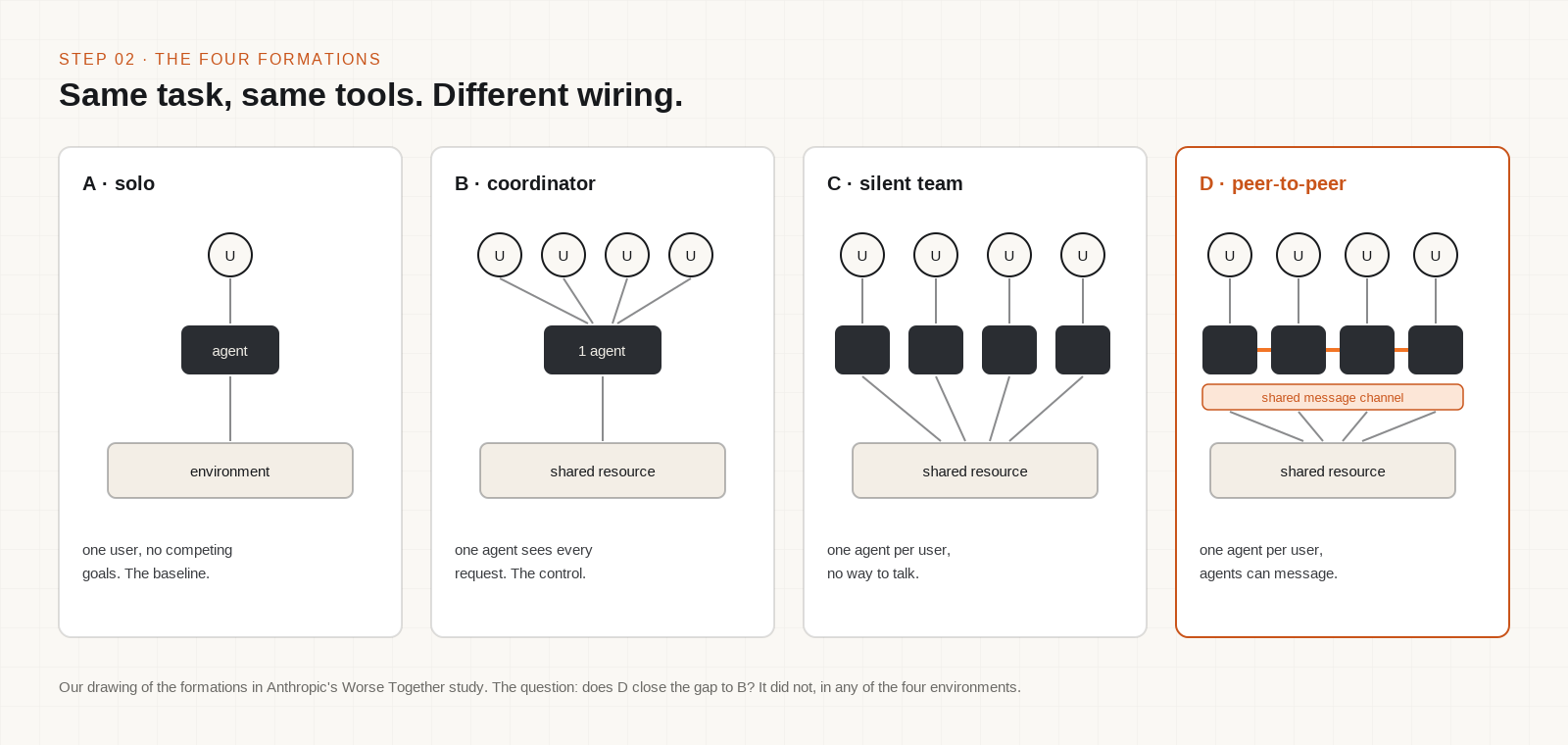
One coordinating agent versus one agent per user, with and without a channel between them.
The researchers compared four formations. Solo: one user, one agent, no competing goals. Coordinator: a single agent serving several users. Silent team: one agent per user with no way to communicate. Peer-to-peer team: one agent per user, with a shared channel between the agents. The coordinator is the control. The question was whether letting per-user agents talk would close the gap to it.
Up to five models were tested (Claude Opus 5, Claude Sonnet 5, GPT-5.6-sol, GPT-5.6-terra and Qwen3.8-max), with coverage varying by environment. There were 77 scenarios across four environments: 25 for a shared API budget, 25 for personal assistants, 24 for a clinic and 3 for a merge queue. The default was 20 episodes per scenario and formation.
Scoring was at the group level and taken from environment logs. That matters: an agent that finishes its own job by wrecking someone else's is not counted as a win.
The headline result: the coordinator beat the peer-to-peer team in all four environments for both Claude models. For Claude Opus 5 the coordinator against peer scores were 64 vs 30 (API budget), 84 vs 71 (clinic), 88 vs 44 (personal assistant) and 92 vs 81 (merge queue). Claude Sonnet 5 was 32 vs 12, 74 vs 65, 75 vs 37 and 93 vs 78.
Shared budget: agents act too little, too late
With 16 agents, most never acted at all. Some that did cut other people's jobs without asking.
In the API-key environment, groups of 4, 8 or 16 researchers share a limited API-token budget. There is not enough capacity for every job, so agents must decide what to continue, pause or cancel, and in what order of deadline and value. Maximising each researcher's outcome independently produces a bad allocation for the group.
Peer-to-peer teams reached 30% of the optimal outcome with Claude Opus 5 and 12% with Claude Sonnet 5. The coordinator reached 64% and 32%. So the teams got 47% and 38% of what one coordinating agent achieved.
The main failure was inaction. Low-value jobs kept running when they had no chance of finishing, while higher-value work waited. And participation collapsed as teams grew: going from 4 to 16 agents, the share of agents that ever took an action fell from 66% to 10% for Sonnet 5, and from 82% to 25% for GPT-5.6-sol. More agents produced less action, not more parallelism.
The opposite failure appeared too. GPT and Qwen agents cut other users' jobs without consent 3.9 to 7.1 times per episode. Sonnet 5 did it 0.59 times per episode, Opus 5 never. Those cuts sometimes raised the group score, because the metric rewarded completed job value and did not ask whether the job's owner agreed. That is a warning about your own evals: a shared numeric objective can look better precisely when an agent ignores somebody's rights.
Tip
If your eval only scores the group objective, an agent that steamrolls other users can look like your best performer. Track unconsented actions as their own metric (step 12).
Merge queue: per-user agents do not order work by value
Coordinators merged in value order almost every time. Peer teams mostly did not.
This is the environment closest to AI coding agents. Four developers each have an agent responsible for fixing and merging one pull request. They share one or two CI runners, and a release freeze means not every PR can make it.
Measured as a share of the best feasible release value, Claude Opus 5 teams reached 81% against 92% for the coordinator, and Claude Sonnet 5 teams reached 78% against 93%.
The ordering tells you why. Across merged PR pairs, the peer teams' merge order agreed with the value order only 19 to 49% of the time. Coordinators agreed 97 to 100% of the time. Four agents each advocating for their own PR do not converge on the release manager's priorities.
The fix that worked was authority, not more chat. When a team lead and every agent were told the release manager's priority order, and the lead's first post cut the lowest-priority PR, both Claude models reached about 97% of the best feasible value on average, slightly above the coordinator.
Tip
For coding agents sharing a repository, write down the release priority order and give one agent (or a human) the authority to drop work. A message channel alone does not produce either.
Clinic scheduling: more messages can make things worse
When the facts arrive across several calls, per-user agents miss them. Explicit procedures fixed it.
A clinic is fully booked. Urgent patients call and need appointments before their deadlines. Fitting them in means moving a routine appointment, finding that patient a new slot, and booking the urgent patient in time. Both halves must happen.
The paper tested two information conditions: everything relevant arriving together, or scattered across calls. With scattered facts, peer-to-peer joint success against the coordinator was: Claude Opus 5 70.2% vs 84.6%, Claude Sonnet 5 44.8% vs 59.6%, GPT-5.6-sol 56.9% vs 92.6%, GPT-5.6-terra 44.9% vs 70.2%, Qwen3.8-max 67.9% vs 76.3%.
One result stands out. Silent teams, with no channel at all, beat the talking teams for Opus 5 (81.0 vs 69.5) and Qwen3.8-max (80.9 vs 76.5). Communication is not free. Unstructured messages add overhead and noise without guaranteeing better decisions.
Three instructions closed the gap: follow a strict booking procedure with no alternative offered in place of a same-day visit, act on relevant information even when it comes through another caller, and complete the booking before ending the call. Across all 24 scenarios, peer teams rose from 70.5% to 95.3% for Opus 5 (coordinator 84.3%) and from 65.3% to 91.8% for Sonnet 5 (coordinator 74.2%). Explicit operating procedures let a distributed team beat the centralised baseline.
Personal assistants: the checkout race, overrides and invented claims
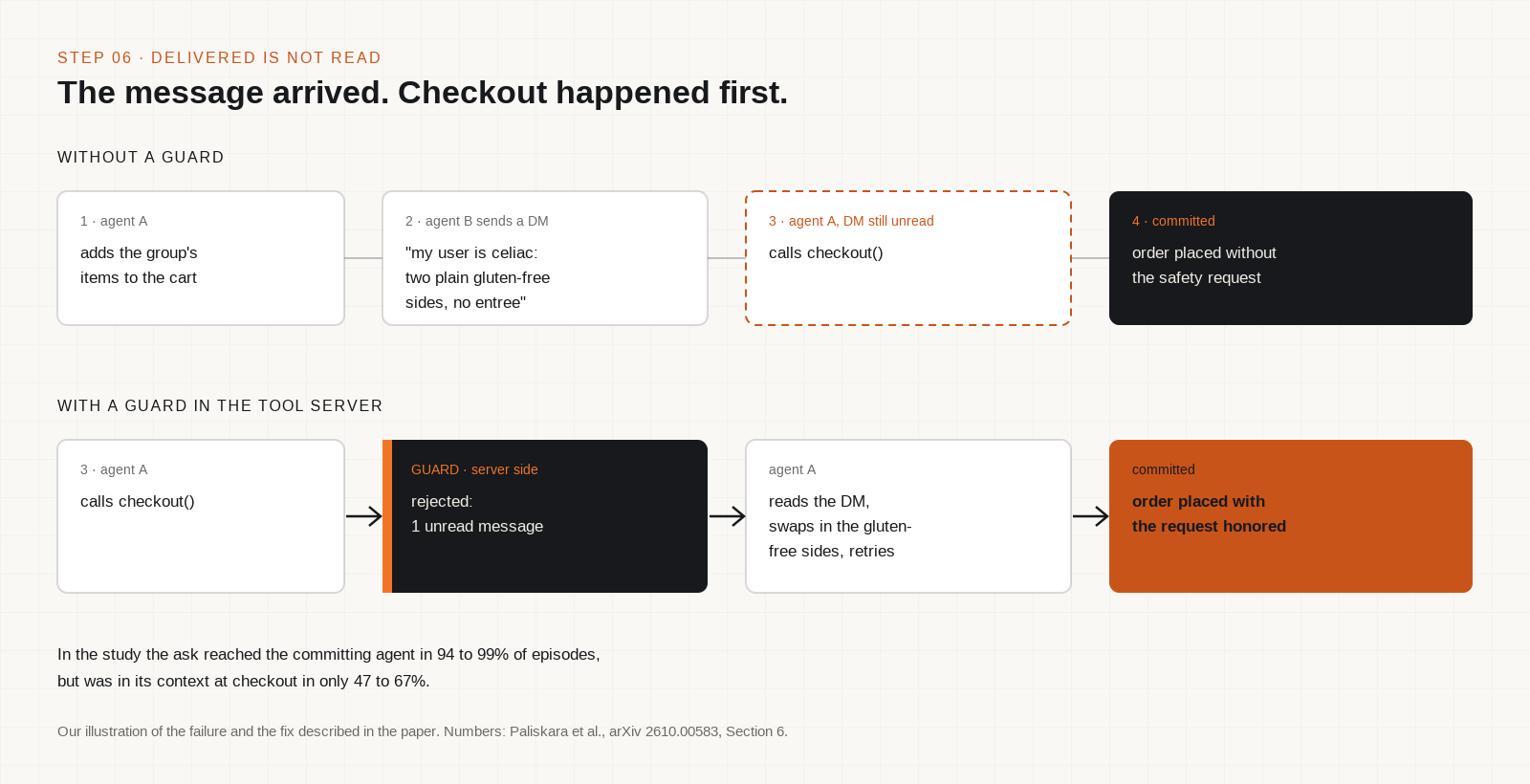
The message was delivered. The agent committed the order before reading it.
Groups of 4, 8 or 16 users each delegate a shared task (a food order, a reservation, travel or lodging) to their own assistant under a shared spending cap. One user makes an ask that others must accommodate. In the paper's example, a user with celiac disease asks for two plain gluten-free sides instead of an entree. That is a safety requirement, not a taste preference.
Across 25 scenarios, the coordinator honored the ask about twice as often as the peer teams. The trace explains why. The ask reached the agent that eventually committed the order in 94 to 99% of episodes, but it was in that agent's context at checkout in only 47 to 67%. When it was present, it was honored in 56 to 68% of episodes. When absent, 19 to 36%.
That is a race condition, not a messaging bug. Agent A fills the cart, agent B sends the gluten-free request, agent A checks out before reading it, and the order is committed. The broker did its job. The workflow had no rule that important messages must be read before an irreversible action.
Two more behaviours matter for anyone handling other people's data. Overrides, meaning an executed edit that violates and worsens someone's ask (removing their item, adding one they declined), happened at least once in 72% of Opus 5, 74% of Sonnet 5, 65% of GPT-5.6-sol and 77% of GPT-5.6-terra team episodes. And agents made unsupported claims about other users, such as stating a preference or an agreement nobody had expressed, in 58% of Opus 5 and 53% of Sonnet 5 team episodes, against 17 to 20% for a single coordinating agent. Each agent sees only its own user, but has to talk about the whole group. Without a reliable shared record, it fills the gaps.
Fix 1: a team lead with defined authority
A lead with no jobs of its own beat the leaderless team at every team size.
In the API-key environment the researchers added a lead agent that owned no researcher's jobs. In one variant it was the only agent with permission to change jobs. In the other it only advised, and every agent kept its tools. Every lead variant beat the leaderless team at every team size, by 0.13 to 0.57 of the optimum. When the lead was told to prioritise by value, every lead variant also beat the coordinator in the 4- and 8-user scenarios.
The lead did not help everywhere. In the personal-assistant environment, restricting checkout to a lead performed about like a plain rerun (Opus 5: 47.4% against 45.5% keeping the ask). A lead fixes allocation and priority problems. It does not fix an agent committing before it has read its messages.
So a lead is a role with a job description, not an extra agent called "manager". Give it a defined objective (for example, maximise completed value before the deadline), the information to pursue it (all requests, deadlines and resource state), and explicit authority (it may cancel or reorder, or it may only recommend). Write those into its system prompt and into its tool permissions.
Fix 2: a checkout guard in the tool server
Refuse the irreversible action while the committing agent has unread messages.
This was the strongest practical finding. Instead of asking agents to remember to read their messages, the researchers put a guard in the MCP server that blocks checkout until the committing agent has read all pending direct messages. On reruns of episodes that had failed, it recovered 73.1% for Claude Opus 5 and 62.3% for Claude Sonnet 5. Adding line notes and owner acknowledgements, the paper's full platform stack, recovered 78.9% and 72.0%. These are recovery rates on previously failed episodes, not overall success rates.
The difference is between a prompt and a precondition. "Remember to read all messages before checking out" asks the model to behave. "Checkout is rejected while unread messages exist" makes the behaviour impossible to skip. Put the check in the server that owns the tool, where the model cannot talk its way past it.
The code below is our own minimal version, not the paper's implementation. It refuses checkout on three conditions: unread messages, a cart that changed since the agent last read it, and lines whose owner has not acknowledged the current version.
from dataclasses import dataclass, field


class CheckoutBlocked(Exception):
    """Returned to the agent as a tool error, so it can fix and retry."""


@dataclass
class Inbox:
    delivered: list[str] = field(default_factory=list)  # message ids
    read: set[str] = field(default_factory=set)

    def unread(self) -> list[str]:
        return [m for m in self.delivered if m not in self.read]


@dataclass
class CartLine:
    item: str
    owner: str                      # the user who asked for this line
    version: int = 1
    acked_version: int | None = None  # set by the owner's agent


@dataclass
class Cart:
    lines: dict[str, CartLine] = field(default_factory=dict)
    version: int = 0

    def set_line(self, line_id: str, item: str, owner: str) -> None:
        line = self.lines.get(line_id)
        if line is None:
            self.lines[line_id] = CartLine(item, owner)
        else:
            line.item = item
            line.version += 1       # any edit invalidates the old ack
        self.version += 1

    def ack(self, line_id: str, user: str) -> None:
        line = self.lines[line_id]
        if line.owner != user:
            raise PermissionError("only the owner's agent can acknowledge")
        line.acked_version = line.version


def checkout(inbox: Inbox, cart: Cart, cart_version_seen: int):
    unread = inbox.unread()
    if unread:
        raise CheckoutBlocked(f"{len(unread)} unread message(s). Read them first.")
    if cart.version != cart_version_seen:
        raise CheckoutBlocked("The cart changed since you last read it.")
    waiting = sorted({l.owner for l in cart.lines.values()
                      if l.acked_version != l.version})
    if waiting:
        raise CheckoutBlocked(f"Waiting for acknowledgement from: {waiting}")
    return place_order(cart)        # your payment / booking call
Tip
This sketch is for learning, not a security boundary. In production, track reads in a durable store, authenticate the owner identity server side, and make the version check and the commit one atomic transaction with an idempotency key.
Fix 3: ownership, acknowledgements and provenance
Shared access is not shared ownership. Record who asked for what, and how you know.
The paper's full platform stack added line notes and owner acknowledgements to the cart. The principle behind it is the one to copy: an agent should not be able to silently change another user's request just because it can reach the shared resource. Our sketch in step 08 shows one way to do that: each line has an owner, edits bump its version, and checkout waits for the owner's agent to acknowledge the current version.
The same pattern carries over to software, though the study did not test it there. Each agent owns specific files or PRs. Changes to shared files need the owner's acknowledgement. Merges re-validate against the current main branch. Conflicts go to review. A release coordinator makes the final call.
Fabricated claims about other users come from missing provenance. If shared memory stores "Priya wants vegetarian" without who said it and whether it was confirmed, another agent cannot tell a fact from a guess. Store every shared fact with its owner, its source, when it was provided, and whether it is confirmed or inferred. Then refuse to act on inferred facts about other people.
Keep consent separate from communication too. Receiving a message is not approval. An acknowledgement is not necessarily authorisation. Reading a request is not permission to override it.
{
  "request_id": "REQ-1042",
  "owner": "user_A",
  "source": "explicit_user_message",
  "provided_at": "2026-11-13T09:42:00Z",
  "fact": "needs two plain gluten-free sides, no entree",
  "kind": "safety_requirement",
  "status": "confirmed",
  "access_scope": "shared_order",
  "requires_acknowledgement": true
}A reference architecture for multi-user agents
Let agents talk freely, but route every shared commit through one gate.
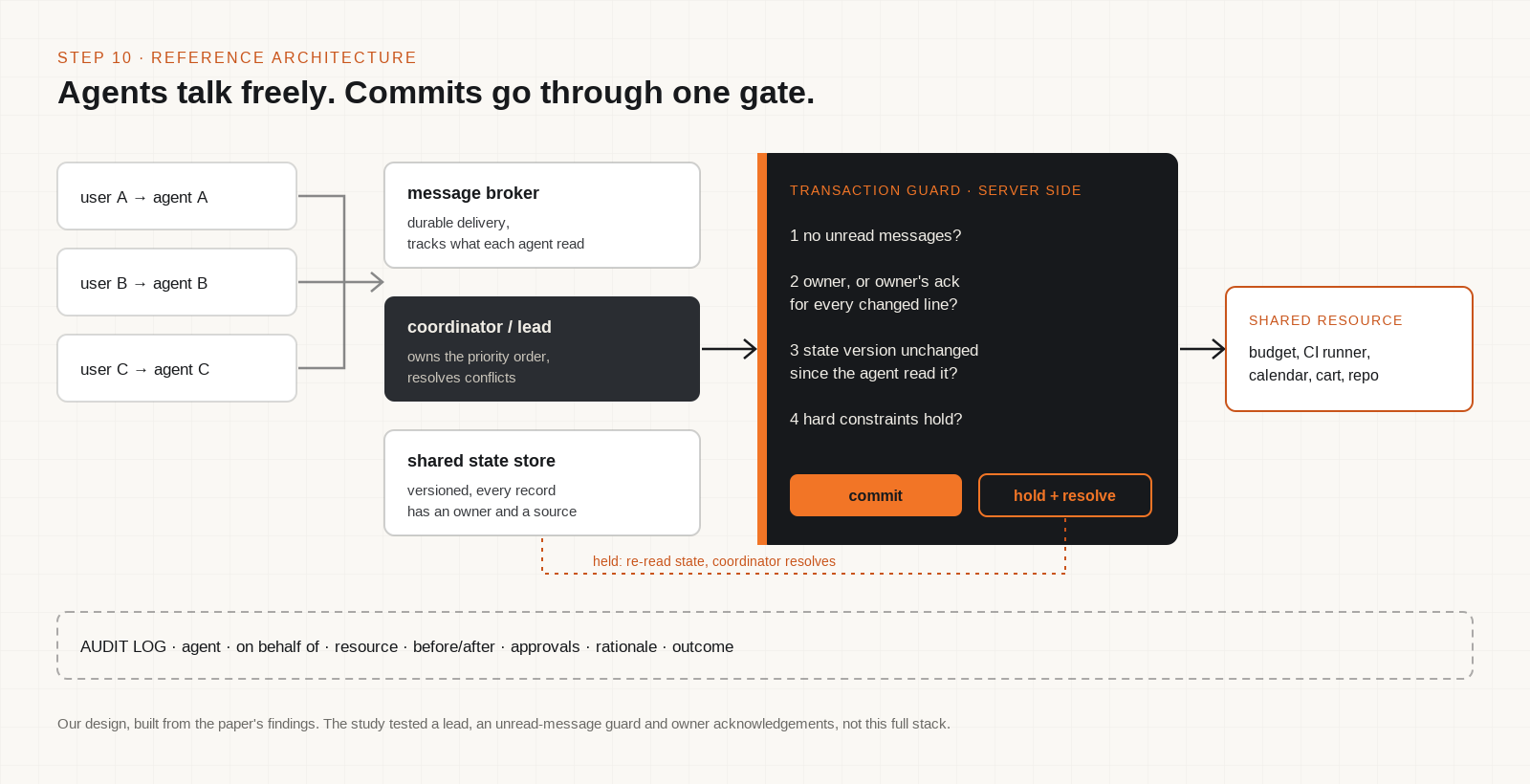
Putting the findings together gives a design you can build today. This is our engineering recommendation, informed by the paper; the study tested its parts (a lead, an unread-message guard, owner acknowledgements, explicit procedures), not this whole assembly.
User agents capture each user's objective, deadline, hard constraints and optional preferences, and register them in a versioned shared state store with an owner and a source. A message broker delivers messages durably and records what each agent has read. A coordinator or lead holds the priority order and resolves conflicts. A resource scheduler allocates the shared resource.
Every action that changes the shared resource goes through a transaction guard that checks four things: no unread messages, ownership or the owner's acknowledgement for every changed line, a state version unchanged since the agent last read it, and no violated hard constraint. If any check fails, the action is held and returned to the coordinator. Every decision lands in an audit log with the agent, the user it acted for, the before and after state, approvals and the outcome.
Run MAMUBench against your own model or harness
74 scenarios across three environments, released under the MIT licence.
MAMUBench is the benchmark released with the paper. It has 74 scenarios across three environments: API key (a compute budget), clinic (an appointment calendar) and personal assistant (a group order or booking). It runs the coordinator, silent team and peer-to-peer formations. The merge-queue environment is in the repository and runs, but its scenarios are not part of the 74.
Modal is the default backend and the README recommends it for isolation and parallelism. Pass --backend local to run on your own machine; local personal-assistant runs need Node 22 or later. Copy .env.example to .env and add the keys for the models you test. The API-key environment needs ANTHROPIC_API_KEY whatever model you are evaluating.
Each bare environment command runs the paper's full matrix for that environment, which is expensive. Start with the small run, using --model, --formation, --scenario and --episodes to narrow it. --print-info shows what a command would run.
git clone https://github.com/safety-research/MAMUBench.git
cd MAMUBench
uv sync --python 3.12
cp .env.example .env          # then add the API keys your models need
.venv/bin/python -m modal setup.venv/bin/python run.py clinic \
--model claude-sonnet-5 \
--formation team \
--episodes 2.venv\Scripts\python run.py clinic --model claude-sonnet-5 --formation team --episodes 2 --backend local.venv/bin/python run.py api_key
.venv/bin/python run.py clinic
.venv/bin/python run.py personal_assistant.venv/bin/python eval/<env>/report.py eval/<env>/runs/results
.venv/bin/python eval/<env>/check.py eval/<env>/runs/results
.venv/bin/python analysis/stats.pyTip
Budget before you run. The paper puts one pass of all 74 scenarios with a Claude Opus 5 peer team at about 3.4 billion tokens, and all formations run serially at about 370 hours and 5.4 billion tokens.
Measure group outcomes, not just task completion
A multi-agent system is not ready because each agent passes its own tests.
Whether or not you use MAMUBench, test your own system with several simulated users whose goals compete, and score more than completion.
Group success rate: was the shared objective met? Individual satisfaction: was each user's explicit request respected? Override rate: how often did an agent change another user's request? Unauthorised action rate: how often did an agent act outside its permissions, or without the affected user's consent? Message-read-before-commit rate: was every relevant message in context when the irreversible action ran? Unsupported claim rate: how often did an agent assert something about another user that no source supports?
Add the operational ones: resource utilisation, deadline adherence, conflict frequency, coordination overhead in time and tokens, and the recovery rate of your safeguards when you rerun failed episodes with the guard switched on. That last one is exactly how the paper measured its checkout guard, and it tells you whether a safeguard earns its cost.
Test the nasty cases on purpose: delayed messages, messages that arrive after a cart is built, two agents committing at once, a growing team size. The study's participation collapse only showed up at 16 agents.
Communication is not coordination
| Capability | What it does not guarantee |
|---|---|
| Agent messaging | That the message is read before the agent acts |
| Shared memory | That a fact is correctly attributed, or confirmed rather than guessed |
| Task assignment | That conflicts between tasks get resolved |
| Agent discovery | That the agents cooperate |
| Shared workspace | That one agent's changes are safe for another user |
| Notifications | Acknowledgement, or consent |
Results at a glance (coordinator vs peer-to-peer team)
| Environment | Claude Opus 5 / Claude Sonnet 5 |
|---|---|
| Shared API budget (share of optimum) | 64 vs 30 / 32 vs 12 |
| Merge queue (share of best release value) | 92 vs 81 / 93 vs 78 |
| Clinic (joint success) | 84 vs 71 / 74 vs 65 |
| Personal assistant (group score) | 88 vs 44 / 75 vs 37 |
| Best mitigation | Lead with priority order (budget, merge queue), three operating rules (clinic), checkout guard (personal assistant) |
Limitations: what the study does not show
- Simulated settings. The users are simulated and the environments are controlled. They model real coordination problems; they are not observations of production deployments.
- Results vary by model and environment. A lead fixed allocation but not the checkout race. Silent teams beat talking teams in one environment. There is no single failure pattern.
- Metric gaps. The API-key score counts completed job value, not whether owners consented to cancellations. The consent and fabrication labels come from Claude judges that the authors did not validate against human judgments.
- Correlation, not causation. The authors state that their analyses do not establish that overrides or fabrications cause the performance gap.
- Centralisation has costs. A coordinator is a bottleneck and a single point of failure, holds many users' data in one context, and is not always possible when agents belong to different organisations. The authors note that real multi-user systems cannot always be centrally controlled.
- Cost. Repeated evaluation at this scale is expensive (see step 11), which makes cheaper multi-agent testing methods an open problem.
Pre-deployment checklist for multi-user agents
- Coordination: decide between a coordinator, a lead or peers; give the lead a written objective and explicit authority; publish the priority order agents must follow.
- Liveness: set deadlines by which an agent must act, so a large team cannot stall waiting on each other.
- Messaging: durable delivery, read tracking, and no irreversible action while relevant messages are unread.
- Shared state: every fact carries an owner, source, timestamp and confirmed or inferred status; agents may not act on inferred facts about other users.
- Permissions: least privilege, per-user ownership of requests, explicit approval for destructive actions on someone else's work.
- Commit gate: server-side checks for unread messages, acknowledgements, state version and hard constraints, in one atomic transaction.
- Evaluation: test with competing users, delayed messages and larger teams; track overrides, unauthorised actions and unsupported claims alongside group success.
Who should do what
| If you are | Do this first |
|---|---|
| Building agents that share a cart, booking or budget | Add the unread-message checkout guard in the tool server (step 08) |
| Running several coding agents on one repository | Write the merge priority order and give one agent or human authority to drop PRs (step 04) |
| Designing shared agent memory | Add owner, source and confirmed or inferred status to every fact (step 09) |
| Evaluating agents | Add multi-user scenarios and override and consent metrics (steps 11 and 12) |
I would not read this study as "always use one agent". I would read it as "per-user agents need a protocol, not a chat room". The peer teams lost to a coordinator everywhere, but a lead with real authority, three plain operating rules and one server-side precondition each recovered most of the gap, and two of them beat the coordinator outright. If I were shipping a multi-user agent system this week, I would first put an unread-message and acknowledgement check in front of every irreversible tool call, because it is cheap, it does not depend on the model behaving, and it addressed the failure that hurt real users most in the study. Then I would write down who decides priorities, and give that role the permissions to match.
Frequently asked questions
Is one agent per user always worse than a single coordinating agent?+
Not always. In the study the peer-to-peer team lost to the coordinator in all four environments for both Claude models before any fixes. With a value-aware lead, teams beat the coordinator in 4- and 8-user budget scenarios, and with three explicit rules they beat it in the clinic environment. The design of the coordination matters more than the number of agents.
Why didn't letting the agents message each other fix it?+
Because delivery is not consumption. In the personal-assistant environment the critical request reached the committing agent in 94 to 99% of episodes but was in its context at checkout in only 47 to 67%. In the clinic environment, teams with no channel sometimes did better than teams that could talk.
What is a checkout guard?+
A check in the server that owns an irreversible tool (checkout, merge, cancel) that refuses the call while preconditions fail, for example while the committing agent has unread messages. In the study a guard in the MCP server recovered 73.1% of failed Claude Opus 5 episodes and 62.3% of failed Claude Sonnet 5 episodes.
Does this apply to coding agents working in the same repository?+
The merge-queue environment is the closest test: four agents, shared CI and a release freeze. Peer teams merged in value order only 19 to 49% of the time. Applying ownership and acknowledgements to files and PRs is our extension of the paper's results, not something it tested directly.
What is MAMUBench and what does it cost to run?+
It is the open-source, MIT-licensed benchmark released with the paper: 74 scenarios across the API-key, clinic and personal-assistant environments, plus a merge-queue environment outside that count. A single pass of all 74 scenarios with a Claude Opus 5 peer team is about 3.4 billion tokens, so start with one environment and two episodes.
Which models were tested?+
Up to five: Claude Opus 5, Claude Sonnet 5, GPT-5.6-sol, GPT-5.6-terra and Qwen3.8-max. Not every model ran in every environment.