Anthropic Academy Courses: How to Enroll and Which Free Claude Course Fits You
Learn how to start a free Anthropic Academy course, save your progress, earn a completion badge, and pick the right Claude course for students, job seekers, developers, and managers.
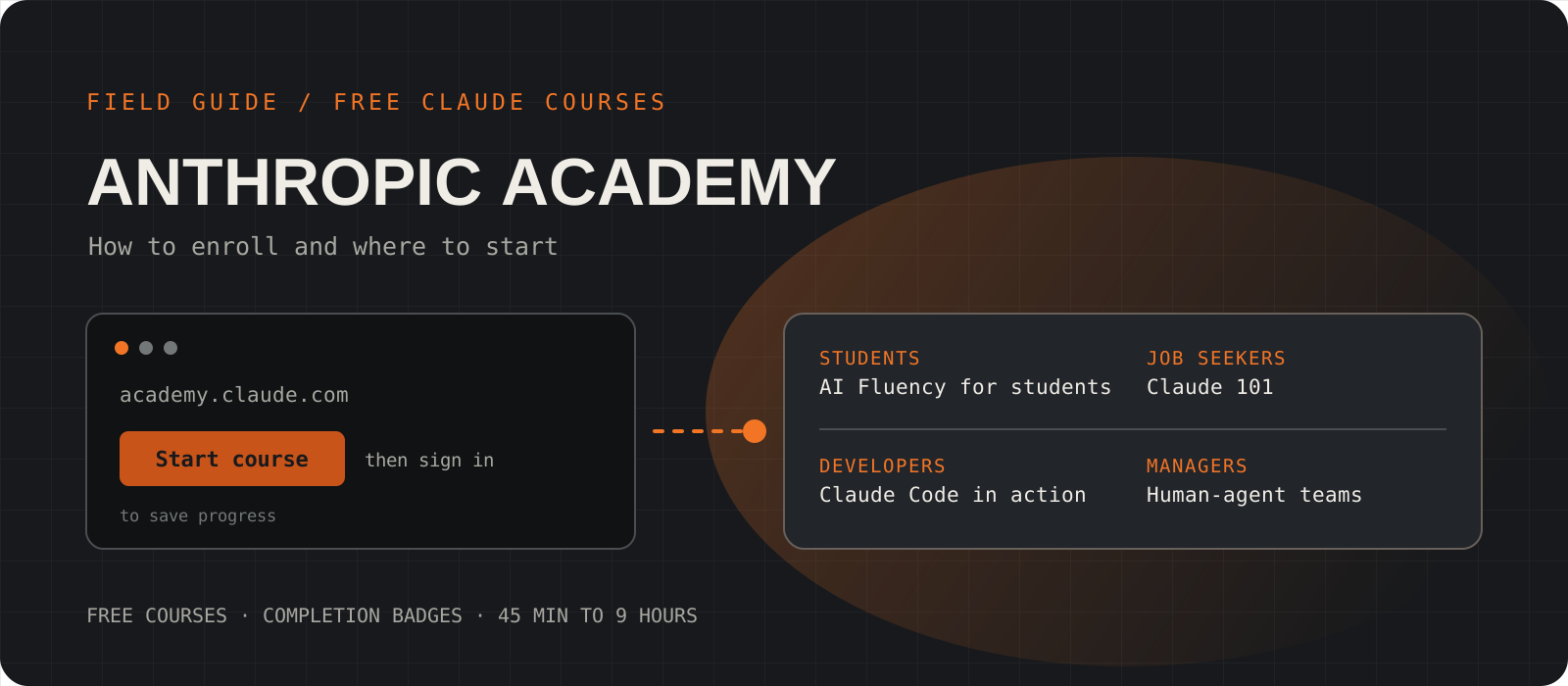
Anthropic Academy courses are free, self-paced lessons on Claude and AI fluency, now hosted at academy.claude.com. To enroll, open a course page and click Start course. You do not need an account to begin, but you must sign in to save progress and earn the completion badge. This guide shows the enrollment steps and then maps each course to the people it suits: students, job seekers, experienced developers, and managers.
System requirements
Cost
Free courses
Anthropic describes the Academy as free courses, tutorials, and use cases. Some hands-on lessons need a paid Claude plan or API credits, which bill separately.
Account
None to start, sign-in to save progress
Start course opens the first lesson without an account. Sign in to save progress plays the same role as enrollment: it keeps your place and records your quiz result.
Claude access
Depends on the course
Claude 101 works with any Claude plan, including Free. Claude Code 101 needs Pro, Max, Enterprise, or an API key. Introduction to Claude Cowork needs a paid plan and the desktop app. Building with the Claude API needs an API key.
Time
45 minutes to 9 hours per course
Introduction to subagents takes about 45 minutes. Building with the Claude API has 67 lessons and takes about 9 hours. The durations are Anthropic's estimates.
Open Claude Academy
Go to academy.claude.com. The old anthropic.com/learn address now redirects there.
Select Browse all resources to see every course, or use a direct course link from this guide. You may also find the older Skilljar catalog at anthropic.skilljar.com. It still lists most of the same courses, but Claude Academy is the current home, so start there.
Read who the course is for before you start
Each course page has a Who this is for section and a Recommended prerequisites section.
Read both sections before you commit time. They tell you if you need coding skills, a paid Claude plan, or an API key. For example, Claude Code 101 expects basic comfort with a code editor and the command line. Building with the Claude API expects Python and basic JSON.
If you are not sure where to begin, use the course map in the next part of this guide.
Click Start course
The Start course button opens the first lesson. No registration form or payment step comes first.
You can read the first lessons without an account. This is a good way to check whether the level fits you before you sign in.
Sign in to save progress
Click Sign in to save progress on the course page. This is the step that enrolls you in practice.
Without sign-in, the Academy does not keep your place between visits and cannot record your quiz result. Sign in before you reach the quiz, so the completion badge is saved to your account.
Set up the tools the course uses
Product courses are hands-on. Prepare the Claude plan, app, or API key the course lists before the practice lessons.
For Claude 101, any Claude account works. For Claude Code courses, install Claude Code and sign in with a Pro, Max, or Enterprise plan, or use an API key. For the API courses, create an API key in the Claude Console and install the Python SDK. API calls are billed per token, so set a low spend limit while you learn.
irm https://claude.ai/install.ps1 | iexcurl -fsSL https://claude.ai/install.sh | bashpip install anthropicPass the final quiz to earn the completion badge
Most courses end with a quiz. Passing it earns a completion badge on your Academy account.
A completion badge shows that you finished a free course. It is not a professional certification. Anthropic's paid Claude certifications are separate exams, and the next part of this guide explains who can take them.
Which Anthropic course should I take first?
| If you are | Start with |
|---|---|
| A student | AI Fluency: Framework and foundations, then AI Fluency for students |
| A job seeker in a non-technical role | Claude 101, then AI Fluency: Framework and foundations |
| A job seeker aiming for a developer role | Claude Code 101, then Building with the Claude API |
| An experienced developer | Claude Code in action, then Introduction to agent skills and Introduction to subagents |
| A manager or team lead | Building effective human-agent teams (beta), then Introduction to Claude Cowork |
| An IT admin or rollout lead | Deploying Claude Enterprise with confidence |
Find the row that describes you and start with the course on the right. Then follow the longer path for your group below.
Best Anthropic courses for students
- AI Fluency: Framework and foundations (14 lessons, about 4 hours). It teaches the 4D framework: Delegation, Description, Discernment, and Diligence. Take it first, because AI Fluency for students recommends it.
- AI Fluency for students (5 lessons, about 3 hours). It covers the difference between using AI to do work and using it to learn, an AI learning partner, career planning, resume help, and interview practice. You also write your own AI use policy.
- AI capabilities and limitations (13 lessons, about 3.5 hours). It explains how large language models work and where they fail. This helps you judge AI answers in your assignments.
- Claude Code 101 (12 lessons, about 1.5 hours), if you study computer science. It is written for new developers who want AI-assisted habits from the start.
Best Anthropic courses for job seekers
Employers ask what you can do with AI, so pick courses that end in work you can show. For non-technical roles, take Claude 101 (13 lessons, about 2.5 hours) and AI Fluency: Framework and foundations. Then practise on a task from the job you want, such as a research brief or a project plan.
For developer roles, take Claude Code 101, Claude Code in action (9 lessons, about 1 hour), and Building with the Claude API (67 lessons, about 9 hours). The API course covers tool use, retrieval, prompt caching, MCP, and agent workflows. Build one small project as you go and put it on GitHub. A working repository says more than a badge.
Best Anthropic courses for experienced developers
- Claude Code in action. It covers long sessions: how to steer, configure, automate, and verify the agent.
- Introduction to agent skills (6 lessons, about 1 hour) and Introduction to subagents (4 lessons, about 45 minutes). Both are short and useful once you use Claude Code daily.
- Claude Platform 101 (13 lessons, about 1.5 hours). It takes you from single API calls to agents that act on real systems.
- Introduction to Model Context Protocol (10 lessons, about 1 hour), then Model Context Protocol: Advanced topics for production MCP servers.
- Claude with Amazon Bedrock (about 8 hours) or Claude with Google Cloud's Vertex AI (about 8.5 hours), if your company runs Claude through a cloud provider.
Best Anthropic courses for managers and team leads
- AI Fluency: Framework and foundations. It gives your team a shared vocabulary for when to delegate work to AI and how to check it.
- Building effective human-agent teams (beta) (5 lessons, about 45 minutes). It covers the move from one person using AI to a team that works with agents.
- Introduction to Claude Cowork (14 lessons, about 2.5 hours). It is for knowledge workers who move information between files and apps. No coding is needed, but a paid plan is.
- Introduction to Claude Tag (11 lessons, about 2.5 hours), if your team works in shared channels.
- Deploying Claude Enterprise with confidence (14 lessons, about 2.5 hours). It is for the person who leads or runs a Claude Enterprise rollout. It walks through five decisions: structure and identity, access, governance, spend, and visibility.
Courses for other groups
- Educators: AI Fluency for educators, Teaching AI Fluency, and AI Fluency for pK-12 educators.
- Nonprofits: AI Fluency for nonprofits.
- Small business owners: AI Fluency for small businesses.
- Designers, writers, and artists: AI Fluency for creative work.
- People who build solutions without a developer title: AI Fluency for builders.
Do Anthropic courses give a certificate?
The free courses give a completion badge after the final quiz. Anthropic also runs paid, proctored Claude certifications: Claude Certified Associate, Claude Certified Developer Foundations, and Claude Certified Architect at Foundations and Professional levels. Anthropic's certification FAQ lists prices from $99 to $175. It says the exams are available only to people at organizations in the Claude Partner Network, with a work email on the company domain. Certifications last 12 months.
If you are a student or an independent job seeker, you cannot book these exams today. Use the free courses and a public project instead.
Points to consider
- The courses teach Claude. The AI Fluency courses transfer to other AI tools, but the product courses assume Claude and its features.
- Free courses can still lead to costs. Cowork lessons need a paid plan, and API lessons spend API credits.
- Course lists and durations change often. Check the course page for current prerequisites before you start.
- A completion badge is not a hiring credential on its own. Pair it with work you can show.
If I had one free afternoon, I would take AI Fluency: Framework and foundations, because it is the base that the other fluency courses build on. Then I would pick one product course for my role and finish it with a real task. Developers should spend their time on Claude Code in action and the API course rather than collect badges.
Frequently asked questions
Are Anthropic Academy courses free?+
Yes. Anthropic describes them as free courses. Some lessons need a paid Claude plan or API credits for the hands-on parts, and those bill separately.
Do I need an account to enroll?+
No account is needed to start. Click Start course to open the first lesson. Sign in when you want to save progress and record your quiz result.
Which course should a complete beginner take?+
Take Claude 101 if you want to use Claude at work right away. Take AI Fluency: Framework and foundations if you want a general method for working with any AI tool.
Can I put the completion badge on my resume or LinkedIn?+
You can list the course you completed. Describe it as a course completion, not a certification, and link to a project that shows what you learned.
Can I take the Claude Certified Architect exam?+
Only if you work at an organization in the Claude Partner Network and register with a company email. Anthropic's certification FAQ lists the Architect Foundations exam at $125.
What is the difference between Claude Academy and anthropic.skilljar.com?+
Claude Academy at academy.claude.com is the current home, and anthropic.com/learn redirects there. The Skilljar site is the older catalog. It still lists most of the same courses.