Claude Haiku 5.5 as a Subagent: Benefits, Costs, and Trade-offs
Learn where Claude Haiku 5.5 fits as a subagent under a larger lead model, what it costs per token, and how to measure cost per successful task before you switch.
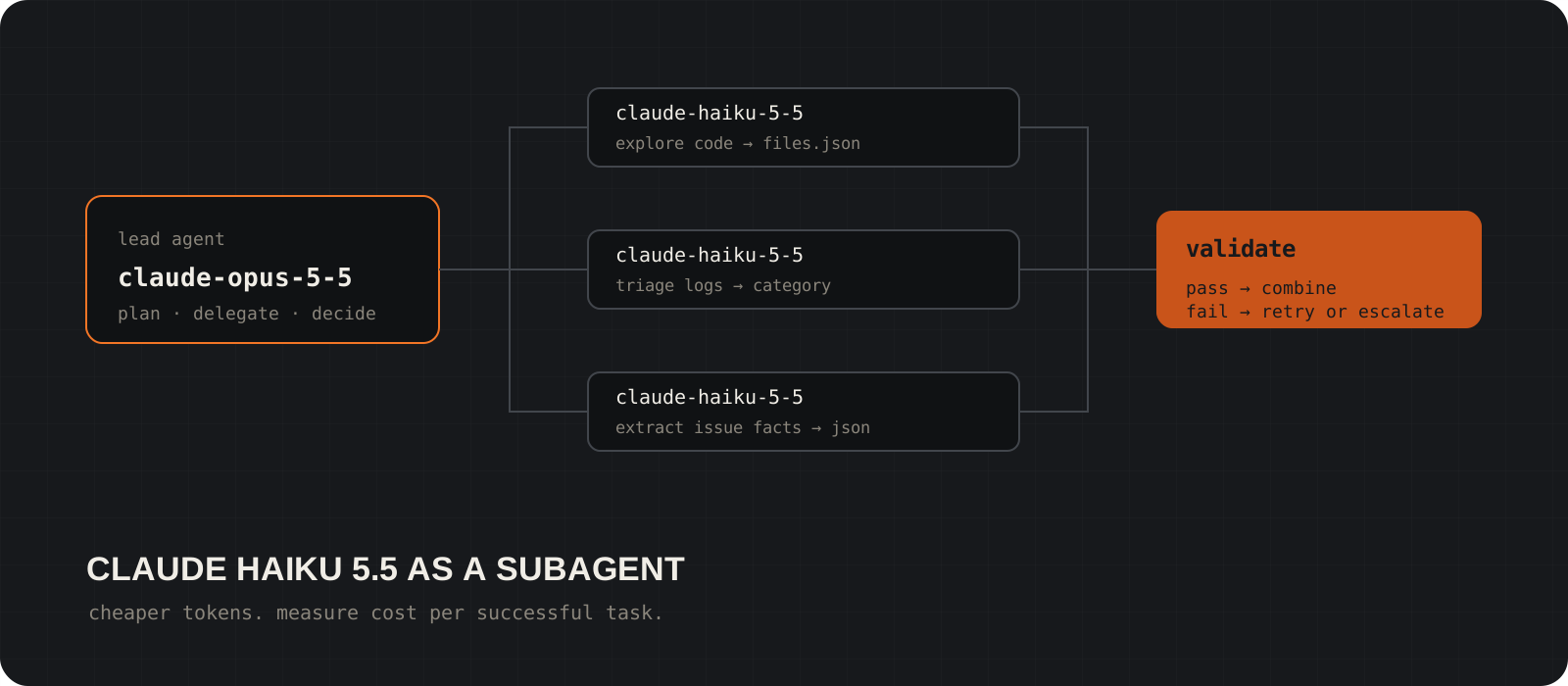
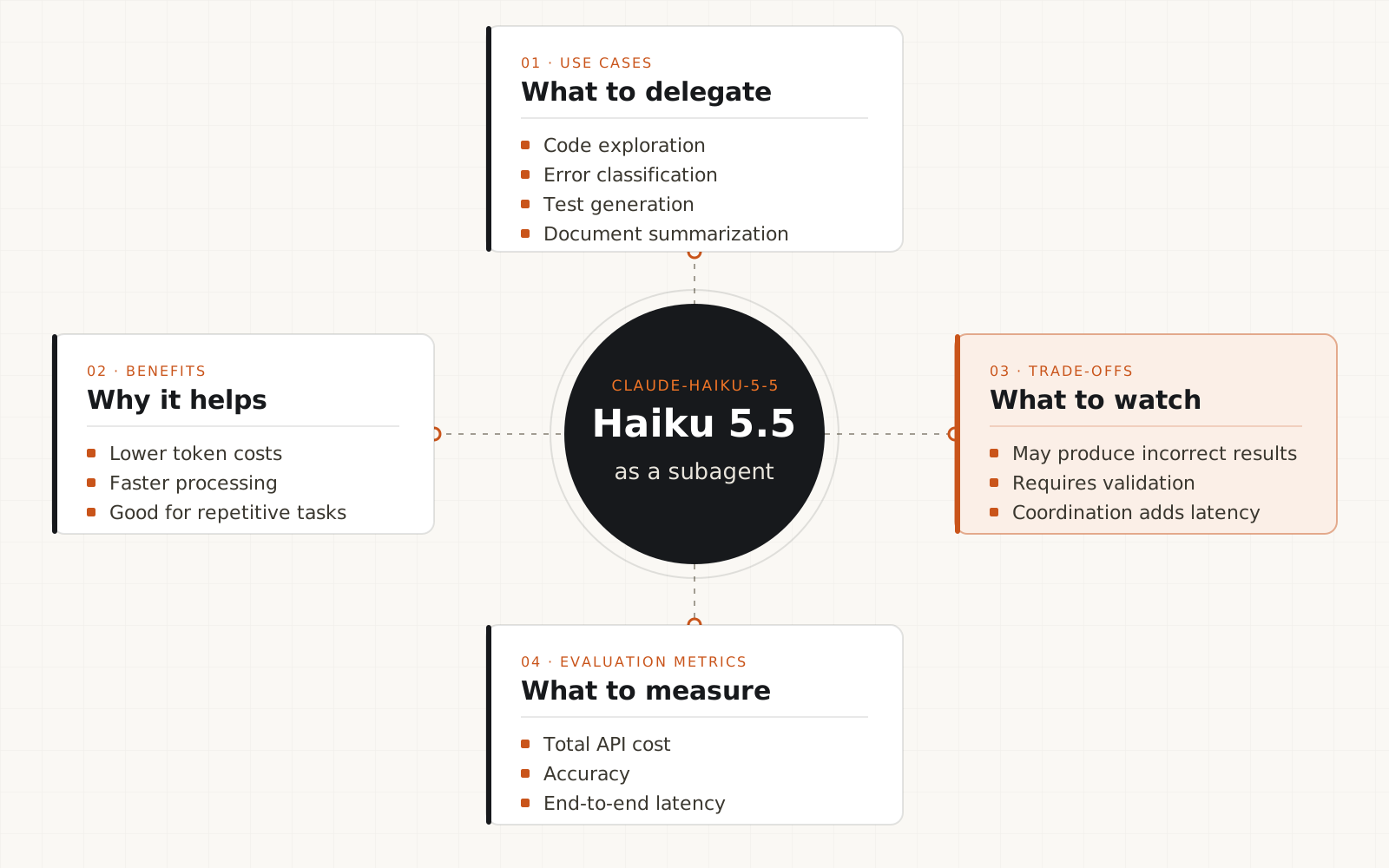
Claude Haiku 5.5 is a good candidate for a subagent: the smaller model a lead agent hands focused jobs to, such as searching a codebase, sorting error logs, or summarizing an issue thread. The lead agent, usually Opus 5.5 or Sonnet 5.5, keeps the planning and the final decision. Haiku 5.5 is priced from $0.10 per million input tokens, and Anthropic says it costs around 75% less to run than Haiku 4.5 on average. A cheap request is not the same as a cheap workflow, though. Retries, bad outputs, and extra validation can eat the savings, so this guide shows where Haiku fits and how to measure cost per successful task on your own work before you switch.
System requirements
Model access
Claude API key, or a cloud platform with Haiku 5.5
The model ID is claude-haiku-5-5 on the Claude API, Google Cloud, Microsoft Foundry, and Claude Platform on AWS. On Amazon Bedrock it is anthropic.claude-haiku-5-5.
Lead model
Claude Opus 5.5 or Sonnet 5.5
Anthropic positions Haiku 5.5 as a subagent alongside these two. Any orchestrator works, including Claude Code subagents or your own loop.
Python (for the examples)
Python 3.10 or later with the anthropic package
Used for the escalation example and the cost formula. Windows, macOS, and Linux all work.
Evaluation set
20 to 50 real tasks with known good answers
This is our practical recommendation, not a vendor rule. Use tasks from your own backlog. A benchmark score tells you little about your codebase.
What is Claude Haiku 5.5 as a subagent?
A small, fast model that takes delegated work from a larger lead agent.
In a multi-agent setup, one lead agent plans the work and makes the final call. It hands narrow jobs to subagents: classification, summarization, data extraction, and code exploration are the usual ones. Each subagent returns a result, and the lead agent checks it.
Anthropic released Haiku 5.5 on October 7, 2026, and describes it as built for high-volume, latency-sensitive work such as classification, routing, extraction, and subagent tasks. It has a 1M token context window, up to 128K output tokens, and adaptive thinking with a default effort of medium.
The goal is to lower the total cost of a workflow without lowering its quality. Whether that happens depends on the task, which is why the rest of this guide is about measuring it.
How does an AI subagent workflow work?
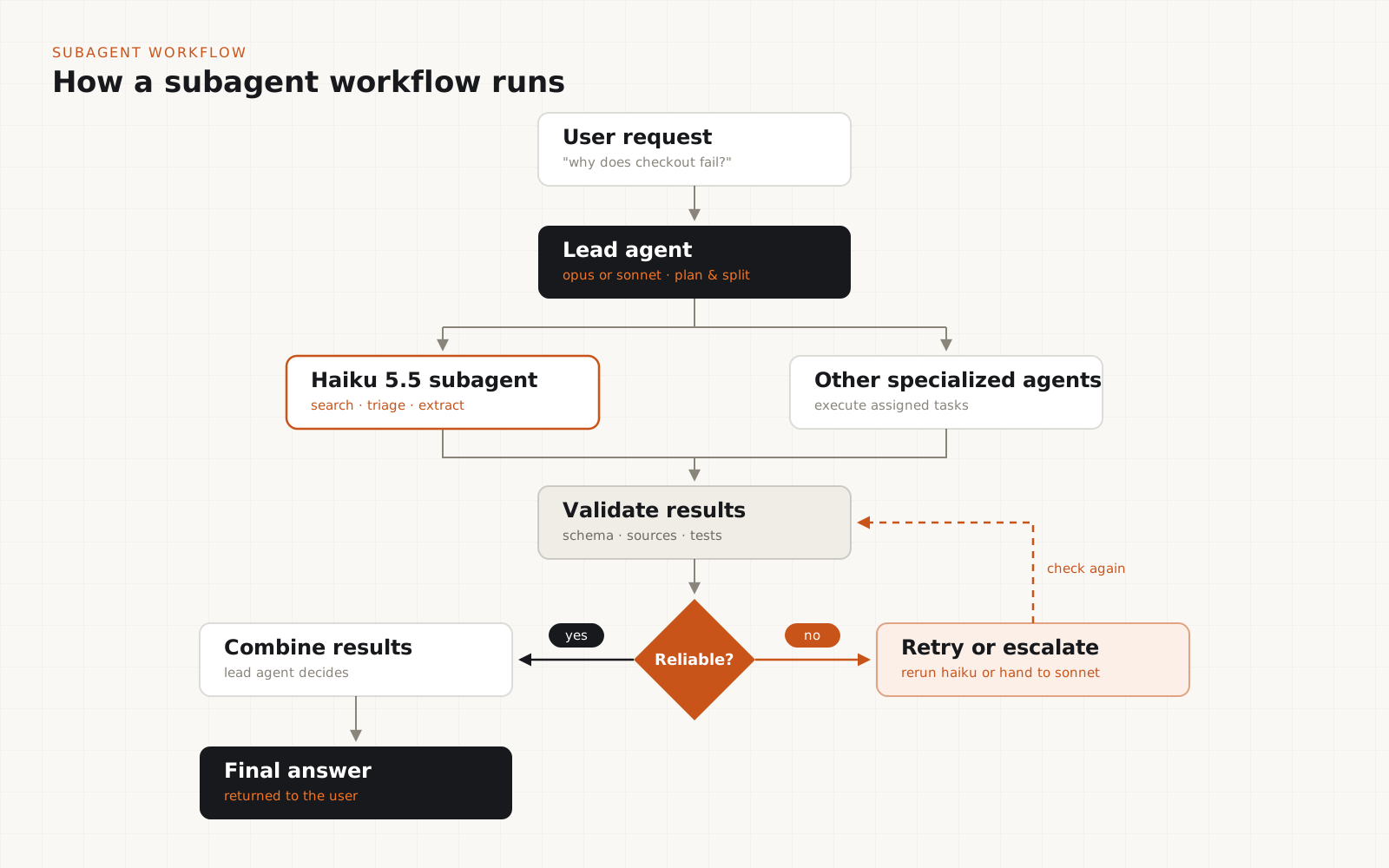
The lead agent splits the task, subagents do the pieces, and nothing reaches the user until it is validated.
The flow is: user request, lead agent, task delegation, subagents, result validation, final answer. The validation step is the one people skip, and it is the one that makes a cheap model safe to use.
If a subagent result passes the checks, the lead agent combines it with the other results. If it fails, the lead agent retries the subagent or escalates the job to a stronger model. In a software-development agent, that might mean Haiku explores the code and drafts test cases while the lead agent decides what to change.
In Claude Code, you can define a subagent as a Markdown file and pin it to Haiku 5.5. The example below creates a read-only code explorer. Limiting it to Read, Grep, and Glob means a wrong answer costs you a bad search result, not a bad edit.
---
name: code-explorer
description: Read-only codebase search. Use to find the files, functions, and call sites related to a bug before any edits are made.
tools: Read, Grep, Glob
model: claude-haiku-5-5
---
You locate code. You never edit files.

Return a JSON object with:
- "files": paths relevant to the request
- "symbols": functions or classes involved, with file:line
- "confidence": "high", "medium", or "low"
- "open_questions": anything you could not confirm

Only list a file you have opened. If you are unsure, say so in open_questions.Where can Claude Haiku 5.5 help in a real workflow?
Narrow jobs with an answer you can check independently.
Picture a coding assistant investigating a bug. Instead of running every step on one large model, it hands smaller jobs to a Haiku subagent:
Code exploration: find the relevant files, functions, and dependencies. Log triage: group error logs and flag likely causes. Test ideas: suggest test cases and edge conditions. Document extraction: pull the key details out of issue reports and technical docs. Structuring: turn findings into JSON the lead agent can read.
The lead agent reviews those results and decides what to do next. Anthropic's launch customers describe the same split. Cognition uses Haiku 5.5 as the helper next to an Opus 5.5 lead, and Rogo uses a Haiku subagent to pull revenue figures from filings while a larger model builds the final deck.
Use Haiku for jobs that can be judged on their own. Fixing the bug, deciding on a design, and anything touching security should stay with the lead model and an independent check.
How do you validate output and escalate when it fails?
Ask for structured output, check it in code, and hand the job to a stronger model if the check fails.
The cheapest reliability tool is a schema. Ask Haiku for JSON, parse it, and reject anything that does not match. The script below classifies an error log with Haiku 5.5 and escalates to Sonnet 5.5 when the reply is not valid JSON, uses an unknown category, or reports low confidence.
One detail for Haiku 5.5: leave out temperature, top_p, and top_k. Anthropic's model page says a non-default value for any of them returns a 400 error.
import json
import anthropic

client = anthropic.Anthropic()
CATEGORIES = {"config", "dependency", "network", "code_bug", "unknown"}

PROMPT = """Classify this error log. Reply with JSON only:
{{"category": one of {cats}, "cause": "<one sentence>", "confidence": "high" | "medium" | "low"}}

Log:
{log}"""


def classify(model: str, log: str) -> dict | None:
    msg = client.messages.create(
        model=model,
        max_tokens=1024,
        messages=[{"role": "user", "content": PROMPT.format(cats=sorted(CATEGORIES), log=log)}],
    )
    text = next((b.text for b in msg.content if b.type == "text"), "")
    try:
        result = json.loads(text)
    except json.JSONDecodeError:
        return None
    if result.get("category") not in CATEGORIES or result.get("confidence") == "low":
        return None
    return result


def triage(log: str) -> dict:
    result = classify("claude-haiku-5-5", log)
    if result is None:
        result = classify("claude-sonnet-5-5", log)  # escalate
    return result or {"category": "unknown", "cause": "needs a human", "confidence": "low"}


print(triage("psycopg.OperationalError: connection to server at 10.0.3.12 port 5432 failed: timeout expired"))python3 -m pip install anthropic
export ANTHROPIC_API_KEY="your-key-here"py -m pip install anthropic
$env:ANTHROPIC_API_KEY = "your-key-here"Tip
Log every escalation. If Haiku escalates on more than a small share of tasks, you are paying for two calls on those tasks and the savings shrink fast.
How should developers evaluate Claude Haiku 5.5?
Run the same tasks three ways and compare cost per successful task, not price per token.
Take one representative set of tasks and run it through three setups. Larger model only: Opus 5.5 or Sonnet 5.5 handles the whole workflow. Haiku only: Haiku 5.5 handles the task directly. Hybrid: Haiku does the delegated work and a larger model plans and validates.
For each setup, record total API cost, end-to-end latency, accuracy, task completion rate, retries, and how often a human had to step in. Then divide.
Cost per successful task = total workflow cost ÷ successfully completed tasks. A setup that is cheap per call but fails a third of the time can lose to a pricier one that finishes the job.
runs = {
    # setup: (total cost in USD, tasks attempted, tasks completed correctly)
    "opus-only":  (12.40, 40, 37),
    "haiku-only": (1.10, 40, 26),
    "hybrid":     (4.30, 40, 36),
}

for name, (cost, attempted, ok) in runs.items():
    print(f"{name:11} success {ok}/{attempted}  cost per success ${cost / ok:.3f}")
Tip
The numbers in this script are placeholders to show the arithmetic, not results we measured. Replace them with totals from your own runs.
What does Claude Haiku 5.5 cost?
| Model | Input / output per million tokens (base price) |
|---|---|
| Claude Haiku 5.5, prompts up to 100K tokens | $0.10 / $0.50 |
| Claude Haiku 5.5, prompts over 100K tokens | $0.50 / $2.50 |
| Claude Sonnet 5.5 | $2 / $10 |
| Claude Opus 5.5 | $4 / $20 |
Haiku 5.5 pricing depends on prompt length. Prompts up to 100,000 tokens get the low rate. Longer prompts cost five times as much per token. Anthropic says this works out to around 75% lower average running costs than Haiku 4.5: 90% lower for requests up to 100,000 tokens and 50% lower above that. These are vendor-reported figures, not a promise for your workload.
One catch when comparing with Haiku 4.5: Haiku 5.5 uses the newer tokenizer, so the same text counts as roughly 30% more tokens. The per-token discount is still large, but measure real bills, not list prices.
The trade-offs worth knowing
- Retries cost money. Every failed Haiku call that you rerun or escalate adds a second bill to that task.
- Coordination adds latency. A lead agent that waits on subagents and then validates their output can be slower end to end than one model working alone.
- Small models make confident mistakes. Without a schema check, source references, or tests, a wrong summary looks the same as a right one.
- Long prompts change the math. Above 100,000 tokens the Haiku 5.5 rate rises fivefold, so a subagent that reads a whole repository at once is no longer cheap.
- Hard reasoning still needs a stronger model. Complex debugging and security-sensitive decisions belong with the lead model and an independent check.
- Permissions should match the risk. Give subagents the fewest tools they need. A read-only explorer cannot break anything.
Use Haiku 5.5 for narrow, checkable subagent jobs like search, triage, and extraction, keep Opus 5.5 or Sonnet 5.5 as the lead, and do not switch until cost per successful task beats your current setup on your own tasks.
Frequently asked questions
Is Claude Haiku 5.5 suitable for AI agents?+
Yes, for focused work such as classification, summarization, data extraction, and code exploration. Anthropic positions it as a subagent next to Opus 5.5 and Sonnet 5.5. Keep planning and final decisions on the larger model.
Does a smaller model always reduce costs?+
No. Retries, errors, escalations, and orchestration overhead can make the complete workflow more expensive. Compare cost per successful task, not price per token.
Should every subagent use the same model?+
No. Pick each subagent's model by task complexity, accuracy needs, latency, and risk. A log classifier and a security reviewer should not share a model by default.
How can developers improve subagent reliability?+
Write clear instructions, limit tool permissions, validate structured output in code, ask for source references, run automated tests, and escalate to a stronger model when the subagent reports low confidence.
What is the model ID for Claude Haiku 5.5?+
claude-haiku-5-5 on the Claude API, Google Cloud, Microsoft Foundry, and Claude Platform on AWS. On Amazon Bedrock it is anthropic.claude-haiku-5-5.