Gemini 4 Argon for AI Agents: Context Caching, the 1M-Token Window, and Long-Context Workflows
What Gemini 4 Argon's 1M-token window, implicit context caching, and introductory API pricing mean for agent builders, and how to keep long-context workflows fast and affordable.
Google announced Gemini 4 Argon on October 13, 2026, and three details in the launch matter most to agent builders: a 1M-token limit shared by input and output, a 95% discount on cached input tokens, and introductory API pricing that doubles on December 1. For coding agents, research assistants, and document-processing workflows, these details shape both how well an agent performs and what it costs to run. This guide explains each one, corrects a common assumption about caching on Argon, and lays out a practical way to manage long-context workflows.
System requirements
Who should read this
Developers building agents that read large codebases or document sets
Coding agents, research agents, and support agents that reuse the same instructions or reference material across many requests benefit most.
Model ID
gemini-4-argon
Listed as the stable model ID in the Gemini API model docs. Thinking is supported at low, medium, and high levels.
API access
A paid Gemini API tier
Google's pricing page says Gemini 4 Argon is not available on the free tier or the Google AI Pro plan. You can try it in Google AI Studio.
Pricing window
Introductory rates through November 30, 2026
Rates double from December 1, 2026. Confirm current rates on Google's pricing page before estimating production costs.
What does the 1M-token context window actually cover?
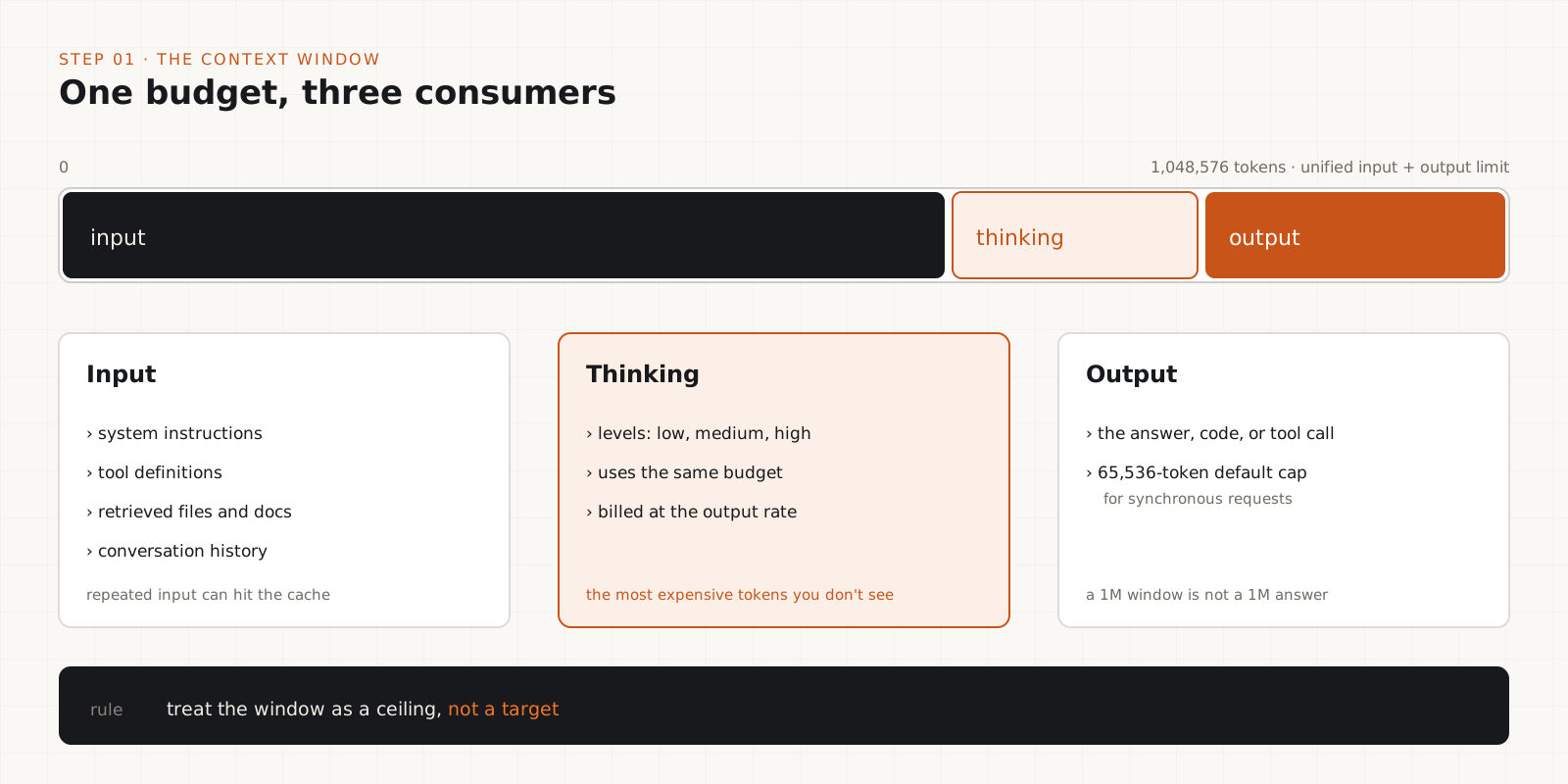
About 1 million tokens, shared by everything the model reads, thinks, and writes in one request.
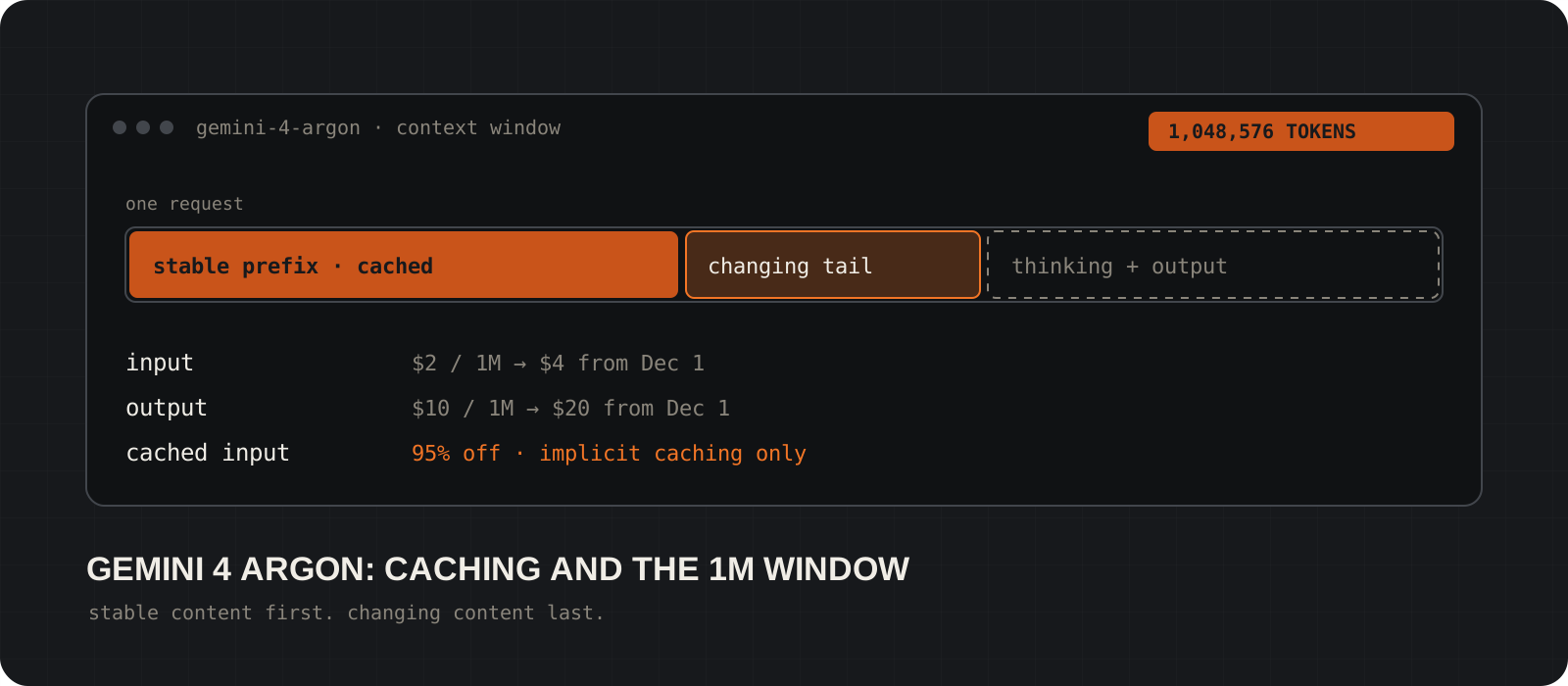
A context window sets how much information a model can handle in one request. Google's model docs list Gemini 4 Argon at 1,048,576 tokens and describe it as a unified input and output limit. Your prompt, the model's thinking tokens, and its response all draw from the same budget.
Output has its own default cap inside that budget: 65,536 tokens for a synchronous request, according to the model docs. So a 1M window does not mean a 1M-token answer by default.
That room is useful when an agent needs to analyze a large codebase, compare several documents, or hold the thread of a long task. A coding agent might read source files, test output, and documentation before proposing a change, and all of it has to fit alongside the model's reasoning and reply.
A bigger window does not guarantee better results. Irrelevant context costs money on every request and gives the model more to sift through. Treat the window as a ceiling, not a target.
How does context caching cut repeated input costs on Argon?
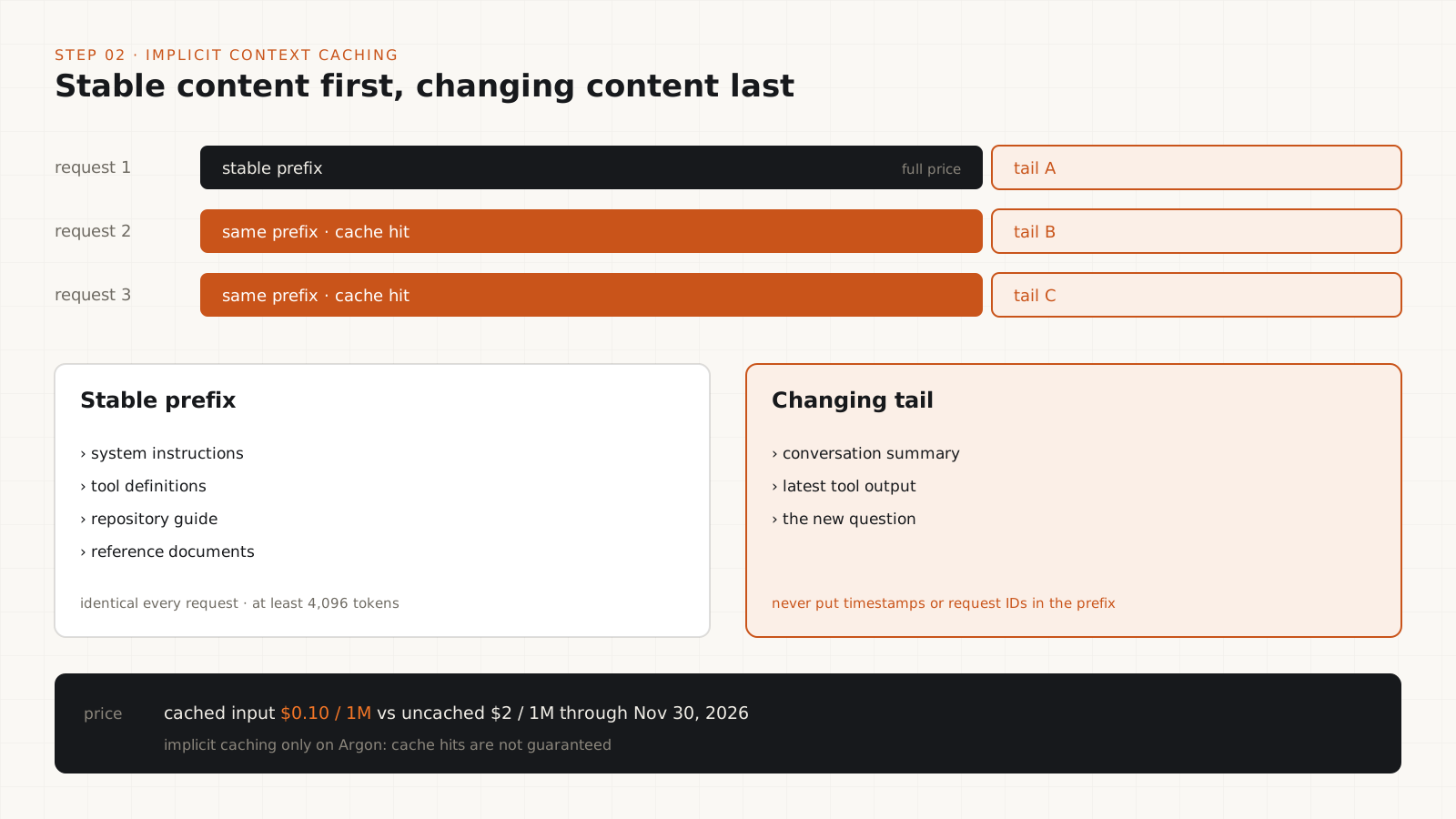
Cached input tokens are billed at 95% off, but on Argon caching is implicit: you earn hits by how you structure prompts.
Agents resend the same material constantly: system instructions, repository guidelines, tool definitions, reference documents. Without caching, you pay the full input rate for that material on every request.
Google prices cached input for Gemini 4 Argon at $0.10 per million tokens during the introductory period and $0.20 from December 1. That is the 95% discount from the announcement, against input rates of $2 and $4.
One correction to a common assumption: Gemini 4 Argon supports implicit caching only. The caching docs say explicit caching, where you create and manage cache objects yourself, is not supported for Argon and later models. Implicit caching is on by default and passes savings through automatically when a request hits the cache. The minimum cacheable input for Argon is 4,096 tokens.
Because you cannot pin a cache, structure is the lever. Google's guidance is to put large, common content at the start of the prompt and send requests with similar prefixes close together in time. Keep the stable part byte-for-byte identical and put the parts that change, such as the user's question or the latest tool result, at the end.
Caching is especially worth designing for in coding agents that reuse repository instructions, research agents working over a stable document set, support agents that reuse product docs, and multi-step workflows that repeat the same background context.
Tip
Check the cached token count in each response's usage data. If it stays at zero, something early in your prompt, such as a timestamp or request ID, is changing between calls.
How should you manage a long-context agent workflow?
Combine retrieval, a stable cacheable prefix, and token tracking instead of filling the window by default.
Identify relevant information: retrieve only the documents or code files the current task needs.
Reuse stable context: keep instructions and reference material in a fixed prefix so repeated requests can hit the implicit cache.
Track token consumption: monitor input, cached input, thinking, and output tokens per task, not just per request.
Manage long conversations: summarize completed steps and keep the decisions that matter, so history does not grow without limit.
Validate results: check generated code, extracted facts, and tool outputs before the agent acts on them.
For very large repositories or document collections, retrieval-augmented generation (RAG) complements a long-context model by supplying the relevant pieces on demand. The two are not rivals: retrieval decides what goes in, and the large window gives that material room.
Tip
Summarizing history at the end of the prompt does not break the cache. Rewriting the instructions at the start does.
What does Gemini 4 Argon cost, and when does the price change?
$2 input and $10 output per million tokens through November 30, 2026, then $4 and $20.
Google's announcement and pricing page list introductory Standard-tier rates of $2 per million input tokens and $10 per million output tokens through November 30, 2026. From December 1, 2026, the rates are $4 and $20. Output pricing includes thinking tokens.
That makes the price change a planning item. An agent you benchmark in November will cost twice as much per token in December, so budget against the December rates.
Caching and retrieval attack different costs. Caching lowers the price of input you repeat. Retrieval and concise prompts reduce how much input you send at all. Thinking level and output length control the most expensive tokens. Use all three.
Where can developers use Gemini 4 Argon?
The Gemini API and AI Studio for building agents, Antigravity for Google AI Ultra subscribers, and GitHub Copilot on supported plans.
Gemini API and Google AI Studio: the route for building your own agents, with Batch, Flex, and Priority inference supported, according to the model docs.
Google Antigravity: available to Google AI Ultra subscribers, per Google's announcement.
GitHub Copilot: generally available since October 13, 2026 for Copilot Pro+, Max, Business, and Enterprise plans, in the model picker across VS Code, Visual Studio, Copilot CLI, the Copilot coding agent, the GitHub Copilot app, JetBrains IDEs, Xcode, and Eclipse. GitHub says the rollout is gradual.
If you are building an agent, evaluate API access, usage limits, and cost controls. If you mostly work inside an IDE, a coding-assistant integration may be all you need. Eligibility differs between products, so check each one's documentation before choosing.
Worked example: what caching can save on a stable prefix
| Without cache hits | With cache hits on requests 2 to 50 |
|---|---|
| 50 × 200K tokens at $2 per 1M | 1 × 200K at $2, then 49 × 200K at $0.10 per 1M |
| $20.00 for the prefix | $0.40 + $0.98 = $1.38 for the prefix |
| From December 1: $40.00 | From December 1: $2.76 |
Take an agent that sends the same 200,000-token prefix of instructions and reference docs on 50 requests, at the introductory input rate. These figures are arithmetic on Google's listed prices, not a measurement, and they assume every repeat request hits the implicit cache, which Google does not guarantee.
Checklist: before you run Argon at scale
- Confirm your API tier has access: Argon is not on the free tier or the Google AI Pro plan.
- Budget against the December 1 rates, not the introductory ones.
- Put stable content first and keep it identical across requests; keep the prefix above 4,096 tokens.
- Move timestamps, request IDs, and per-user data out of the prefix.
- Log cached, uncached, thinking, and output tokens per task.
- Retrieve what each step needs instead of loading everything into the window.
- Summarize long histories and validate outputs before the agent acts on them.
Gemini 4 Argon's 1M-token window gives agents room to work with large codebases and document sets, and its 95% cached-input discount can make repeated context cheap. But on Argon caching is implicit, so the savings come from prompt structure, not configuration: stable content first, changing content last. Combine that with retrieval, a sensible thinking level, and per-task token tracking, and plan your budget around the December 1 price change. A bigger window helps only when what you put in it is relevant.
Frequently asked questions
What is Gemini 4 Argon's context window?+
1,048,576 tokens, shared by input and output, according to the Gemini API model docs. Synchronous output defaults to a 65,536-token cap.
Does Gemini 4 Argon support explicit context caching?+
No. Google's caching docs say explicit caching is not supported for Gemini 4 Argon and later models. Implicit caching is on by default and applies automatically when requests share a prefix of at least 4,096 tokens.
How much is the context caching discount?+
95% off the input rate. Cached input is listed at $0.10 per million tokens through November 30, 2026 and $0.20 from December 1, 2026.
How much does Gemini 4 Argon cost?+
$2 per million input tokens and $10 per million output tokens through November 30, 2026. From December 1, 2026, $4 and $20. Output pricing includes thinking tokens.
Can I use Gemini 4 Argon in GitHub Copilot?+
Yes, on Copilot Pro+, Max, Business, and Enterprise plans. GitHub made it generally available on October 13, 2026, with a gradual rollout.