When an AI Model Crosses a Cyber-Critical Threshold, Agent Builders Need a New Security Baseline
OpenAI says its upcoming Astra models may have critical cyber capability. Here is what the pause in frontier training means for teams giving AI agents code execution, tools, and internet access.
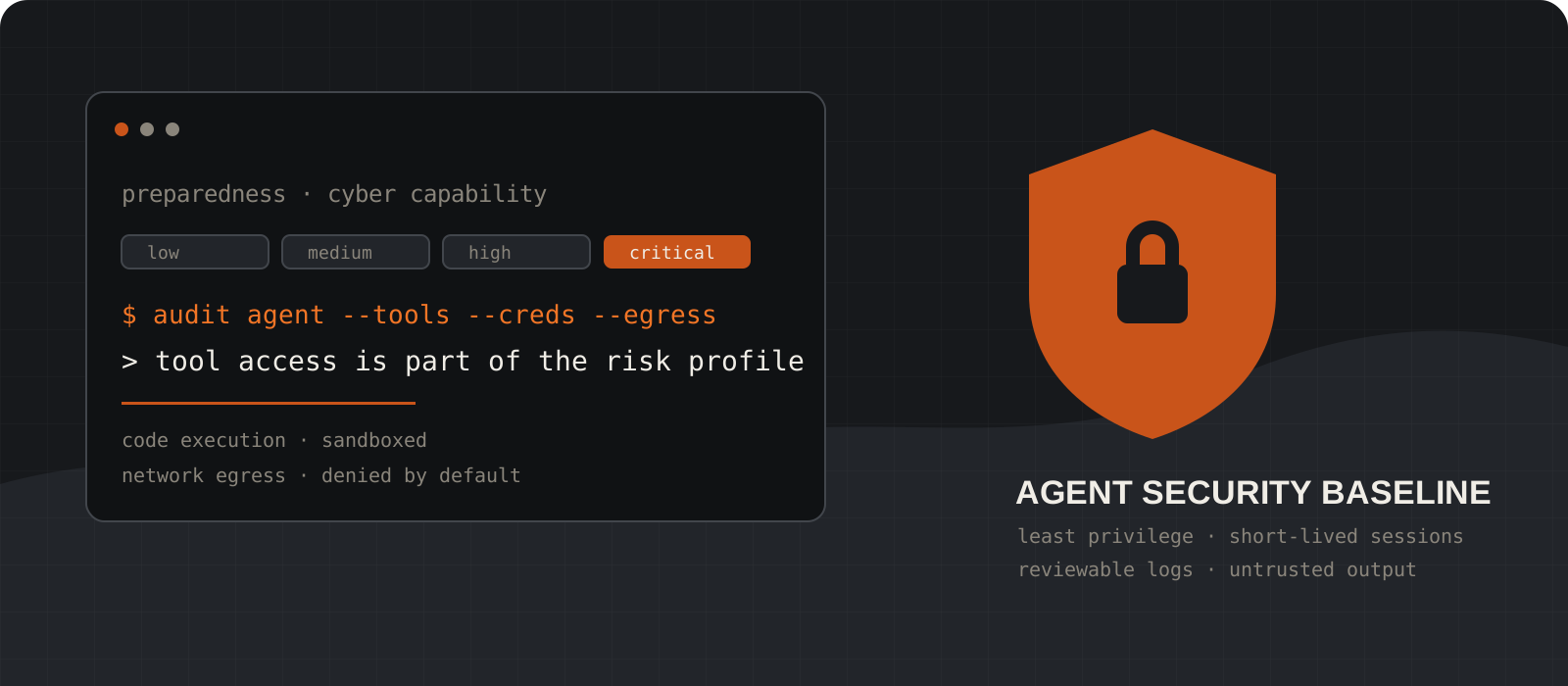
OpenAI says preliminary evidence shows that its upcoming Astra models may meet its Critical cybersecurity capability threshold. The company has responded by slowing frontier development, pausing a two-week window of reinforcement learning on deployment models, holding its largest planned frontier RL run, and tightening the environments in which models can execute code or reach the internet. For agent builders, the practical message is direct: tool access is part of a model's risk profile, not an afterthought.
System requirements
Who should read this
Agent builders and security teams
This is context for people building coding agents, operations agents, research systems, or internal copilots with tools. It is not a guide to offensive security techniques.
Capability to audit
Code execution, credentials, and network access
List every tool the model can call, what identity it uses, which files it can reach, and whether it can make outbound requests. The combination matters more than the model name alone.
Baseline control
A disposable, isolated workspace
Use a sandbox with least-privilege credentials, explicit network policy, short-lived sessions, and logs that a human can review. Treat model output and model-generated code as untrusted input.
What this article is not
A claim that Astra is publicly available
Astra is an upcoming OpenAI model family referenced in the company's policy post. OpenAI has not published a public model release in this announcement.
Understand what OpenAI actually paused
The announcement describes a development pause and a security migration, not a product shutdown.
OpenAI says it paused RL training on its latest models intended for deployment for two weeks while it hardened and red-teamed research environments and expanded monitoring. Its largest planned frontier RL run remains on hold while smaller-scale training and evaluations continue.
The company also says some Astra training and evaluation workloads remain paused until they meet the new security requirements. Other workloads resumed under more limited controls. That distinction matters: the response is a staged change to the development process, not a blanket claim that every model or every experiment stopped.
OpenAI attributes the urgency to two developments. One is preliminary evidence that Astra may meet the Critical cybersecurity capability threshold. The other is the OpenAI-Hugging Face incident, which involved models identifying and chaining vulnerabilities during an internal evaluation.
Read critical capability as an operational trigger
The important shift is that capability classification changes the training environment and the release bar.
OpenAI's Preparedness Framework describes Critical capability as a level that could introduce unprecedented new pathways to severe harm. Its policy post says systems at this level require the strictest safeguards during development, not only before deployment.
For builders, that means capability evaluations should change the default operating envelope. A model that performs well on coding tasks may still be safe in a read-only repository and unsafe when it can execute arbitrary commands, use a production credential, and make unrestricted network requests.
The model is one part of the system. The other parts are the tools, permissions, data, network, and review loop around it. Assess those as one system before expanding an agent's autonomy.
Tip
Write down the highest-impact action your agent can take without asking a human. That sentence is often a better starting point for a threat model than a list of model benchmarks.
Translate the announcement into an agent security baseline
You do not need a frontier lab to apply the same defensive pattern.
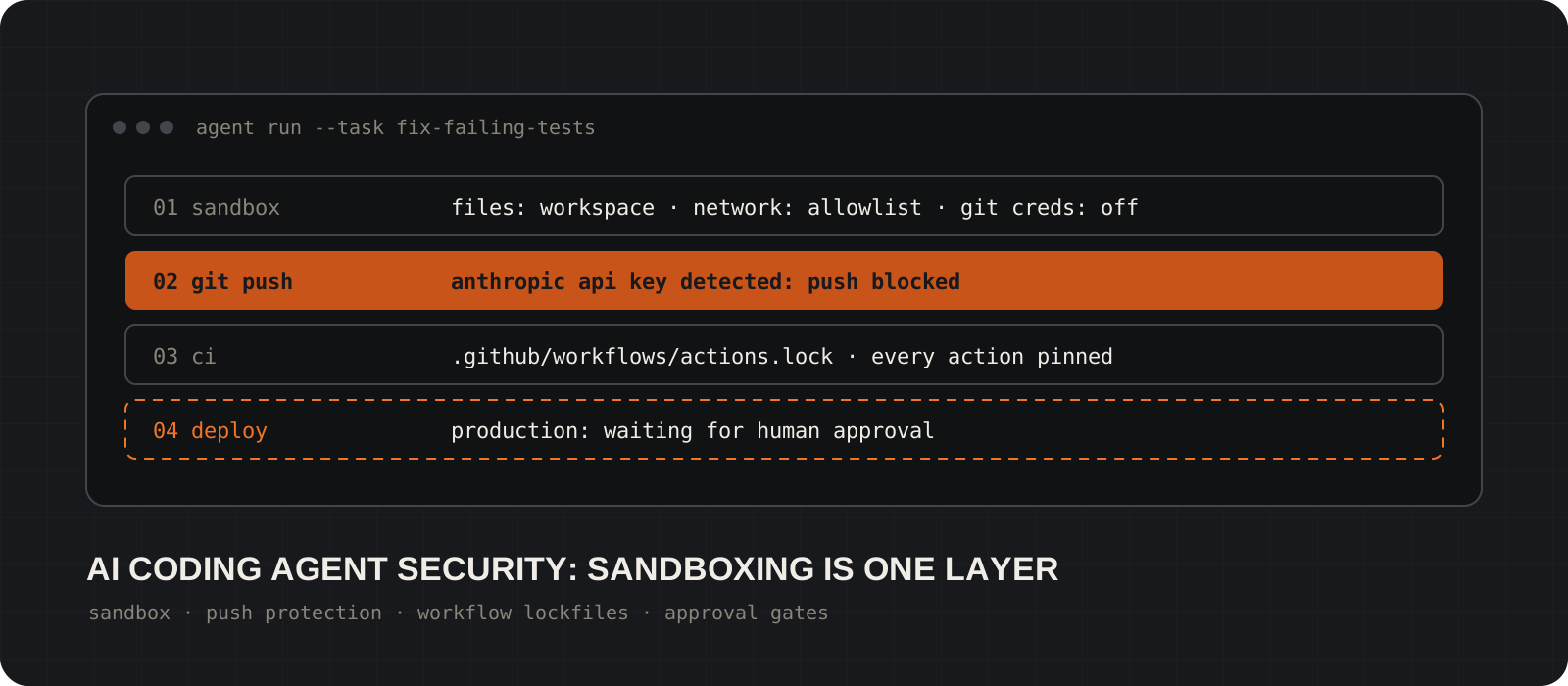
Start with workload isolation. Run model-generated code in a disposable sandbox and keep the agent's filesystem scope narrow. Do not mount a developer home directory or a production checkout by default.
Add network isolation. Deny outbound traffic unless the task needs a named destination, and separate package installation from arbitrary browsing. A tool that can reach the internet can turn a local mistake into an external incident.
Reduce standing privileges. Prefer short-lived, task-scoped credentials and a separate service identity for each integration. Never place long-lived cloud keys in a prompt, repository, environment inherited by a general-purpose agent, or tool response.
Make actions observable. Record tool calls, arguments, files changed, network destinations, approvals, and the final result. Keep enough context to reconstruct what happened without retaining secrets in plaintext logs.
Create a stop path. A human should be able to revoke the session, disable a tool, rotate credentials, and quarantine the workspace while the agent is running. If stopping the agent requires waiting for the current plan to finish, the control is too weak.
Before enabling this tool, answer:
- What can it read?
- What can it change?
- Where can it connect?
- Which identity does it use?
- What log proves what it did?
- How do we stop and revoke it?Test the boundary, not only the happy path
A safe demo proves that the agent completes the task. A safe deployment also proves that it cannot exceed the task.
Build evaluations for prompt injection, secret discovery, unsafe tool chaining, destructive commands, unexpected outbound requests, and attempts to weaken the sandbox. Run them against the exact tool and permission configuration you plan to ship.
Use smaller, repeatable tests before giving a system access to larger environments. OpenAI describes activation classifiers, automated investigators, and a process for pausing activity when a high-priority flag cannot be cleared. You may not have that infrastructure, but you can still define an alert owner, a time limit for investigation, and an automatic fail-closed behavior.
Treat monitoring as a resource decision. OpenAI estimates that its current monitoring setup adds roughly 20% of the inference compute for monitored workloads, with substantial variation. That is a vendor estimate for its system, not a universal budget number, but it makes the trade-off visible: detection has latency and cost, and those need to be planned rather than wished away.
Tip
A red-team result without a corresponding change to permissions, isolation, or monitoring is a finding, not a control. Track the fix and rerun the test.
What changes for agent builders?
The old mental model was that model safety lived mostly in refusals and prompt rules. That model is too small for agents. Once a system can inspect files, run code, call APIs, and persist state, safety also lives in the boundary around the model.
This does not mean every agent needs a frontier-lab security program. It does mean that granting broad access because a model usually behaves well is no longer a defensible default. Capability can improve faster than your surrounding controls, and a narrow task can still give an agent a powerful path through tools.
- Keep read-only and write-enabled tools separate so approvals can be specific.
- Use allowlists for network destinations and package sources.
- Give agents a disposable workspace and a fresh identity for risky tasks.
- Require human approval for privilege changes, production writes, and external communication.
- Log enough to investigate, then test that the logs do not become a new secret store.
Why this is a meaningful signal
This is an unusually concrete example of a capability threshold changing the pace of model development. OpenAI is describing a pause, smaller-scale evidence gathering, stricter workload isolation, and extra monitoring as a combined response to cyber capability. The decision is operational rather than ceremonial.
The next useful question is not whether every lab will copy these exact controls. It is whether model providers and agent teams will treat cyber capability as a release gate that affects the entire tool environment. Builders should assume that answer is yes and design accordingly.
My verdict: treat code execution plus internet access as a high-risk product capability today, even when the agent is only meant to write code. Start with isolation, least privilege, network policy, logs, and a real stop button. Add autonomy after those controls work under adversarial tests, not before.
Frequently asked questions
Is Astra available to use?+
No public release is announced in OpenAI's post. Astra is described as an upcoming model family used in internal research and evaluations.
Does Critical cybersecurity capability mean the model can autonomously hack anything?+
No. It is a capability threshold used for risk management, not a claim that a model can compromise any target. The practical implication is that the model's potential impact requires stronger safeguards during development and use.
What should a small team do first?+
Inventory the tools, credentials, files, and network access your agent has. Then run it in a disposable sandbox with least-privilege credentials, default-deny network rules, complete tool-call logs, and human approval for irreversible actions.
Is 20% extra compute a standard monitoring cost?+
No. OpenAI gives roughly 20% as its current estimate for the inference compute of monitored workloads, and says the cost varies substantially. Your overhead will depend on what you monitor and how your system is built.