What Is Claude Fable 5.1? A Beginner's Guide to Anthropic's New Agent Model
Learn what Claude Fable 5.1 and Mythos 5.1 are, what they cost, how Fable 5.1 compares to Opus 5, how to switch in Claude Code and the API, and the three breaking changes to fix before you migrate.
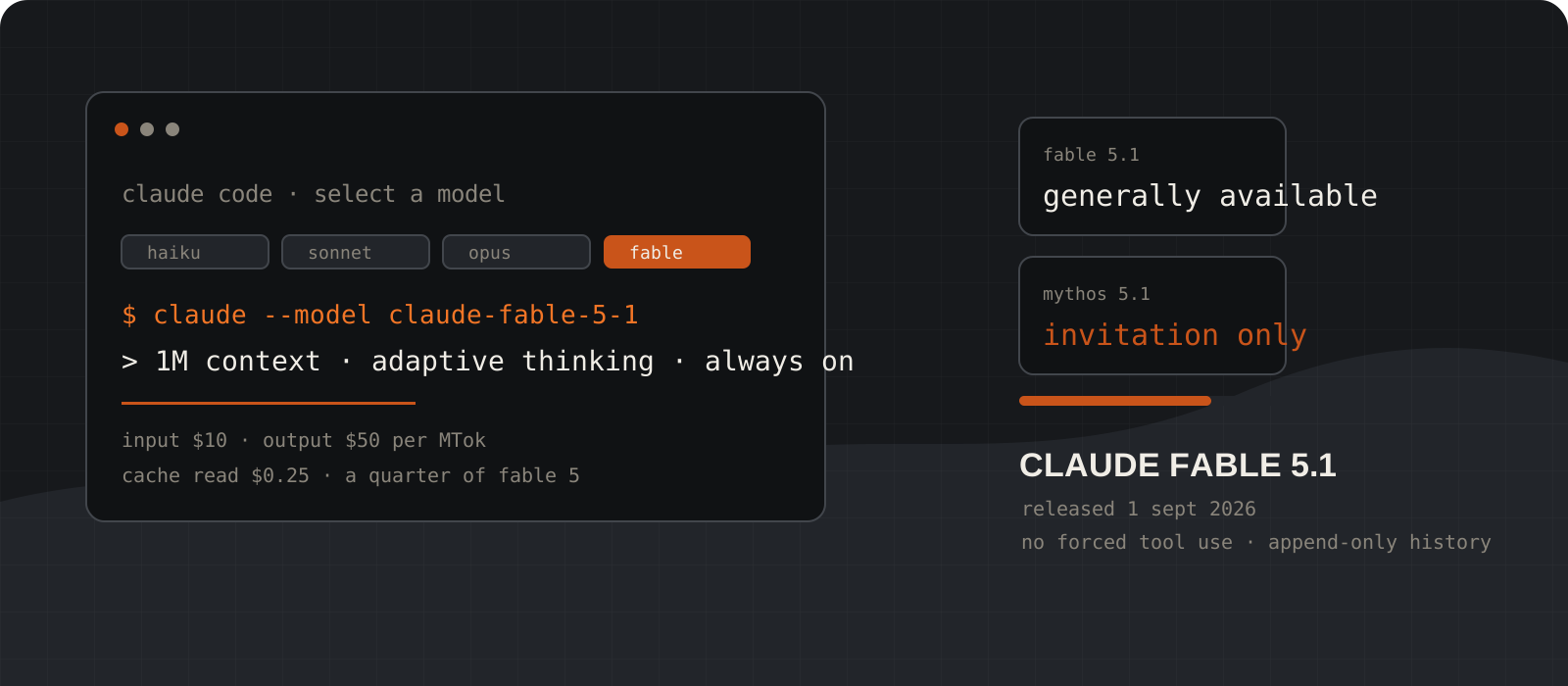
Claude Fable 5.1 is Anthropic's newest model for long-running coding and knowledge work, released on 1 September 2026. Claude Mythos 5.1 is the same model with different safeguards, and it is invitation only. In practice there is one model you can use today: call it as claude-fable-5-1 on the API, or type /model fable in Claude Code. It has a 1M token context window, adaptive thinking that cannot be switched off, and it costs $10 per million input tokens and $50 per million output tokens. That is double Claude Opus 5, which Anthropic still recommends as the starting point for most workloads. The reason to reach for Fable 5.1 anyway is a cache read price of $0.25 per million tokens, a quarter of what Fable 5 charged, which changes the arithmetic of agent loops that re-read the same prefix for hours.
System requirements
Model IDs
claude-fable-5-1 and claude-mythos-5-1
Fable 5.1 is generally available. Mythos 5.1 is restricted to Project Glasswing participants and is requested through an Anthropic, AWS, or Google Cloud account team. Both IDs are pinned snapshots, not floating aliases.
Where it runs
Claude API and four partner platforms
Claude API, Amazon Bedrock as anthropic.claude-fable-5-1, Google Cloud, Microsoft Foundry, and Claude Platform on AWS. There are no open weights and no local option, so every prompt leaves your machine.
Claude Code version
v2.1.255 or later
Older builds do not list Fable 5.1 in the model picker. Run claude --version first, then update before you go looking for it.
Context and output
1M tokens in, 128K tokens out
The full million-token window is both the default and the maximum, priced at the standard per-token rate across the whole range. There is no long-context premium.
Price per million tokens
$10 input, $50 output, $0.25 cache read
Cache writes are $12.50 for the 5-minute lifetime and $20 for the 1-hour lifetime. Batch API requests are half price at $5 and $25. The minimum cacheable prompt is still 512 tokens.
Thinking mode
Adaptive, always on
You cannot disable it. Sending a thinking type of enabled with budget_tokens, or a type of disabled, returns a 400 error. Depth is steered with the effort parameter, which defaults to high.
Knowledge cutoff
June 2026
Later than Opus 5 at May 2026 and Sonnet 5 at January 2026. Anything after June 2026 needs a search tool or a document in the prompt.
Data retention
30 days, no zero-retention option
Fable 5.1 and Mythos 5.1 are Covered Models. They are not available under zero data retention unless Anthropic expressly authorises it, which matters if your compliance posture depends on that setting.
Understand what Fable, Mythos, and Opus each are
Three names, two safeguard levels, and one model you almost certainly cannot access.
Fable 5.1 and Mythos 5.1 are the same underlying model with different safeguards. Fable 5.1 ships with Anthropic's production safety classifiers and is available to every API customer. Mythos 5.1 relaxes some of those constraints for vetted cybersecurity and life-sciences organisations, and it is handed out only through Project Glasswing. If you are reading this without an account team, Fable 5.1 is your model.
Opus 5 is the other current frontier model, and it is not being retired. Anthropic's own model-selection guidance says to start with Opus 5 for most workloads and move to Fable 5.1 for demanding reasoning and long-horizon agentic work, or when your evals on Opus 5 at high effort still fall short. Opus 5 costs half as much and answers faster.
Sonnet 5 at $2 and $10, and Haiku 4.5 at $1 and $5, remain the cheap ends of the lineup. A four-model roster is not a ranking. It is a set of price and latency points, and picking the top one for a classification job wastes money.
One safeguard detail is worth knowing before you plan a project. Life-sciences research and development queries are routed to Anthropic's Opus models regardless of which model you asked for, and access to Mythos 5.1 for that work runs through a Life Sciences Verification Program for credentialed professionals.
Switch to it in Claude Code
It is one command, but it is not the default on any plan.
Claude Code resolves the model from five places, in order: the /model command during a session, the --model flag at startup, the ANTHROPIC_MODEL environment variable, the model field in ~/.claude/settings.json, and ANTHROPIC_DEFAULT_MODEL for new sessions. Whichever you set, the fable alias points at the latest Fable model, which is now 5.1.
No plan defaults to Fable. Max, Team Premium, Enterprise, and API accounts default to Opus 5. Pro and Team Standard default to Sonnet 5. Microsoft Foundry defaults to Sonnet 4.5. You have to ask for Fable every time unless you write it into settings.
Update first. Fable 5.1 needs Claude Code v2.1.255 or later, and an older binary shows you a picker without it in the list. If you want the exact snapshot rather than the alias, pass the full ID.
The best alias is a useful middle ground for a shared configuration: it resolves to the latest Fable where the provider offers one, and falls back to opus where it does not.
claude --version
# needs 2.1.255 or later
claude --model fable/model fable
# or pin the exact snapshot
/model claude-fable-5-1export ANTHROPIC_DEFAULT_MODEL=fable$env:ANTHROPIC_DEFAULT_MODEL = "fable"{
"model": "fable"
}Tip
Fable 5.1 already carries a 1M context window, so the [1m] suffix is only needed for models where the large window is opt-in, such as sonnet[1m] and opus[1m].
Call it from the API
A one-line model swap, then three parameters that will reject your request.
The model ID is claude-fable-5-1 on the Claude API, Google Cloud, Microsoft Foundry, and Claude Platform on AWS. Amazon Bedrock prefixes it as anthropic.claude-fable-5-1. If you are already on Fable 5, changing the string is the whole migration for a simple text call.
Three request shapes that work on older Claude models return a 400 error here, and they carry over unchanged from Fable 5. Prefilling the assistant response is rejected. Non-default temperature, top_p, or top_k values are rejected. Any explicit thinking configuration other than adaptive is rejected. Strip all three before you send.
Effort defaults to high, which is where the model is strongest and also where it is slowest and most expensive. Treat the default as a starting point for evals rather than a setting you never touch.
In Claude Code, the bundled Claude API skill does the mechanical part of the migration across a code base, then hands back a checklist of what still needs a human. It asks you to confirm the scope before it edits anything.
response = client.messages.create(
    model="claude-fable-5-1",
    max_tokens=4096,
    output_config={"effort": "medium"},
    messages=[{"role": "user", "content": "Summarise this repo's build pipeline."}],
)const response = await client.messages.create({
model: "claude-fable-5-1",
max_tokens: 4096,
output_config: { effort: "medium" },
messages: [{ role: "user", content: "Summarise this repo's build pipeline." }],
});/claude-api migrate this project to claude-fable-5-1Fix the three breaking changes before you migrate
Forced tool use, thinking-block binding, and any code that edits conversation history.
Forced tool use is gone. A tool_choice of type any, or of type tool with a name, returns a 400 invalid_request_error, and the same validation applies on the token counting endpoint. The reasoning is that thinking is always on, and a forced call would skip it, pushing the model's working-out into the tool arguments and degrading them. For schema-valid JSON, keep tool_choice on auto and use strict tool use or structured outputs. To make the model reach for a tool, say so in the prompt.
Thinking blocks now record which model produced them, and they travel in one direction. Fable 5.1 can read thinking blocks from earlier Claude models. No earlier model can read Fable 5.1's. A router that falls back from Fable 5.1 to Opus 5 mid-conversation loses the reasoning for the turns that run there. The blocks are dropped before the model sees them, they are not billed, and the drop is invisible unless you send the thinking-binding-controls-2026-08-01 beta header and read the input_transformations array.
The third one catches home-grown agent loops. Modifying anything before a Fable 5.1 thinking block invalidates every thinking block after it: editing or reordering an earlier turn, injecting a status line you delete on the next request, or rebuilding the system prompt or tools array between requests in the same conversation. The replayed block then fails with a 400 saying the block is bound to a different conversation.
Enforcement depends on your account age. Accounts created on or after 31 August 2026 get the check by default. Older accounts only see it if the request sets a prefix_mismatch_behavior under thinking.block_binding. Claude Code, claude.ai, Claude Managed Agents, and the Claude Agent SDK keep the prefix intact for you, so this is a problem for code that builds the messages array itself.
The fix is to treat the conversation as append-only. Server-side context editing and compaction do not count as edits, and neither does moving cache_control markers, changing effort, or trimming a leading run of thinking blocks from the oldest end.
# 1. Run a normal session with the beta header:
#      anthropic-beta: thinking-binding-controls-2026-08-01
#
# 2. Set thinking.block_binding.prefix_mismatch_behavior to "drop_block"
#    so requests keep working instead of failing with a 400.
#
# 3. Log every entry in the response's input_transformations array.
#    reason: "prefix_binding_mismatch" means your code edited the history.
Tip
Run the drop_block check against a real session before you move production traffic. A loop that injects a per-turn reminder and removes it on the next request looks fine on Fable 5 and starts returning 400s here.
Use the new controls, then re-tune effort
Three additive betas make long agent sessions cheaper and less silent.
Per-message effort lets you change the effort level partway through a conversation without invalidating the prompt cache. Raise it for the hard step, drop it for the routine ones. Send the mid-conversation-output-config-2026-07-01 beta header and add a system message carrying an output_config. Fable 5.1, Mythos 5.1, and Opus 5 all support it.
Turn-scoped system messages solve the reminder problem that used to require editing history. Set clear_at to next_user_message on a system message and its text carries system-prompt authority for the current turn, then stops rendering once a later user message exists. The message stays in the array and you keep sending it back verbatim, so the cache keeps matching, later thinking blocks stay valid, and a cleared message costs no input tokens. The beta header is mid-conversation-system-clear-at-2026-08-21.
Progress updates are the fix for a long agentic turn that looks frozen. Fable 5.1 writes short status notes between tool calls, but they arrive as thinking blocks, and the default thinking display of omitted returns them empty. Set the display to updates with the thinking-display-updates-2026-08-18 beta header and you get the status lines as text while the reasoning stays hidden. Any thinking block with non-empty text is then something you can show a user.
One caution on effort. At low effort Fable 5.1 answers from memory more often and calls search or retrieval tools less. If a turn needs fresh information, raise effort for that turn rather than accepting a confident answer built on a June 2026 cutoff.
# header: anthropic-beta: mid-conversation-output-config-2026-07-01
{
  "role": "system",
  "content": [],
  "output_config": {"effort": "low"}
}# header: anthropic-beta: mid-conversation-system-clear-at-2026-08-21
{
"role": "system",
"clear_at": "next_user_message",
"content": "Results landed in your inbox. Check it before running more code."
}# header: anthropic-beta: thinking-display-updates-2026-08-18
{
"thinking": {"display": "updates"}
}Fable 5.1 or Opus 5: how the two compare
| Claude Fable 5.1 | Claude Opus 5 |
|---|---|
| $10 / MTok input, $50 / MTok output | $5 / MTok input, $25 / MTok output |
| $0.25 / MTok cache read, 0.025x input | $0.50 / MTok cache read, 0.1x input |
| 1M context, 128K max output | 1M context, 128K max output |
| Adaptive thinking, always on | Adaptive thinking |
| Comparative latency: slower | Comparative latency: moderate |
| Reliable knowledge cutoff June 2026 | Reliable knowledge cutoff May 2026 |
| Forced tool use returns a 400 | Forced tool use supported |
| Not the default on any Claude Code plan | Default on Max, Team Premium, Enterprise, API |
| 30-day retention, no zero-retention option | Standard retention options apply |
These are the two current frontier models, and choosing between them is a price and latency decision more than a capability ranking. Opus 5 is half the price at moderate latency. Fable 5.1 is the slower model with the later knowledge cutoff and the very cheap cache read.
- Prices are from Anthropic's pricing page, checked on 2 September 2026. Verify before you budget.
- Both models use the tokenizer introduced with Opus 4.7, which produces roughly 30% more tokens for the same text than models older than 4.7. A per-token comparison against a Sonnet 4.6 baseline will understate the cost.
- Fast mode is an Opus 5 and Opus 4.8 feature. It is not available on Fable 5.1.
- Permitted fallback targets for a refused Fable 5.1 request are Opus 4.8 and Opus 5. A refusal arrives as HTTP 200 with a stop reason of refusal, so handle it in code rather than treating it as an error path.
What actually improved
| Benchmark, Anthropic's figures | Fable 5.1 vs Fable 5 |
|---|---|
| Terminal-Bench-Science 0.1, agentic scientific research | 52.6% vs 24.7% |
| Terminal-Bench 4.0, agentic coding | 55.8% vs 42.0% |
| AutomationBench, business workflows | 31.4% vs 17.1% |
| OSWorld 2.0, computer use, partial credit | 77.9% vs 72.9% |
| OSWorld 2.0, computer use, strict | 41.7% vs 36.1% |
| CursorBench 3.2.0, agentic coding | 73.4% vs 70.5% |
| Humanity's Last Exam, no tools | 60.9% vs 57.8% |
| GDPval-AA v2, knowledge work | 1853 vs 1723 |
Anthropic's published comparison is against Fable 5, and the gains concentrate in agentic work rather than single-turn answers. The largest reported movements are on terminal-driven benchmarks, where a task runs for a long time and the model has to recover from its own mistakes.
- These are vendor-reported numbers on vendor-selected benchmarks. Treat them as a signal about where to run your own evals, not as a substitute for running them.
- Anthropic also reports that its cyber safeguards now trigger far less often, with Claude Code users seeing around 60% fewer interventions per session, and that the model may be used to discover software vulnerabilities but not to develop exploits.
- Text generated by Fable 5.1 and Mythos 5.1 carries Anthropic's statistical text watermark on every platform. Images and video produced through the code execution tool carry signed C2PA Content Credentials when retrieved through the Files API. The watermark adds no tokens and carries no information about you or your organisation.
The trade-offs worth knowing
The behaviour changes are the part most likely to surprise you, because none of them require a code change to show up. Anthropic documents seven, and each has a prompting fix rather than a setting.
- Parallel tool calling is more variable. Fable 5.1 may issue one tool call per turn where Fable 5 batched several. Answer quality holds, but you pay in tokens, round trips, and wall-clock time. A one-line batching instruction in the prompt brings it back.
- It writes fewer progress updates during long tool runs, especially at high effort. If your interface depends on narration, ask explicitly for an opening line, periodic updates, and a closing recap.
- At low effort it answers from memory more often and searches less. Raise effort for turns that need current information.
- Its prose is denser in places, with longer sentences and fewer paragraph breaks, and it uses bold, headers, and lists less than earlier Claude models. Anti-formatting rules you wrote for older models can now suppress structure the content needs.
- When summarising documents it is more likely to reproduce source passages without marking them as quotations. That is a real risk if you publish the output.
- When editing text files it is more likely to rewrite the whole file than make a targeted edit. The result is usually correct and the output token bill is not.
- It is the slowest model in the current lineup, and adaptive thinking cannot be turned off. For a latency-sensitive path, that alone rules it out.
Does it run offline, and what does a real session cost?
cached prefix tokens x turns x $0.25 / 1,000,000   # Fable 5.1 cache reads
cached prefix tokens x turns x $0.50 / 1,000,000   # Opus 5 cache reads

# Then add, for each model:
#   uncached input tokens x input rate
#   output tokens x output rate
#
# Opus 5 wins on input and output. Fable 5.1 wins on cache reads.
# Which total is smaller depends on your prefix-to-output ratio.
It does not run offline. There are no open weights for Fable 5.1 or Mythos 5.1 and no local inference option. Every prompt, every file your agent reads, and every tool result goes to Anthropic or to whichever cloud platform you route through. Both models carry 30-day data retention and are not available under zero data retention unless Anthropic expressly authorises it.
For cost, the number that moves is the cache read. A long agent session sends the same prefix again on every turn. On Fable 5, a 200,000-token cached prefix read back 50 times cost about $10 in cache reads at $1 per million. On Fable 5.1 that same pattern costs about $2.50. Anthropic puts the overall saving at around 25% relative to Fable 5 for typical workloads, and up to roughly 45% for highly agentic work.
The discount only applies to cache hits. Uncached input is still $10 per million and output is still $50 per million, both double Opus 5. If your workload is short prompts with long answers, the cache read price does nothing for you and Fable 5.1 is the expensive option with no compensating saving.
Our verdict: do not pick by model name, pick by the shape of your traffic. Run one eval on Opus 5 and Fable 5.1 with your real prompts, then compare total cost per completed task rather than price per token. Long agent loops that re-read a large cached prefix for hours are where Fable 5.1 earns its price. Short interactive turns and latency-sensitive paths are where Opus 5 stays ahead at half the cost. Whichever you land on, fix the forced tool use and append-only history issues first, because those fail loudly and have nothing to do with which model is better.
Frequently asked questions
Is Claude Mythos 5.1 available to me?+
Almost certainly not. Mythos 5.1 is offered only to approved customers in Project Glasswing, and access is arranged through an Anthropic, AWS, or Google Cloud account team. It shares Fable 5.1's specifications and pricing, so there is no capability you are missing by using Fable 5.1 for ordinary work.
Should I switch from Opus 5 to Fable 5.1?+
Not by default. Anthropic's own guidance is to start with Opus 5 and move to Fable 5.1 for demanding reasoning and long-horizon agentic work, or when your evals on Opus 5 at high effort still fall short. Fable 5.1 costs twice as much per input and output token and is the slower model.
Does Claude Fable 5.1 run offline or locally?+
No. It is an API-only model with no published weights. It is available on the Claude API, Amazon Bedrock, Google Cloud, Microsoft Foundry, and Claude Platform on AWS. Everything you send is processed remotely and carries 30-day retention.
Why does my tool_choice suddenly return a 400 error?+
Fable 5.1 and Mythos 5.1 do not support forced tool use. A tool_choice of type any, or of type tool with a name, returns a 400 invalid_request_error. Keep tool_choice on auto and use strict tool use or structured outputs for schema enforcement, then state in the prompt when a tool applies.
What is the effort parameter, and what should I set it to?+
Effort controls how much the model thinks before answering. It defaults to high on Fable 5.1, which is the strongest setting and also the slowest and most expensive. Start there, then lower it per task and measure. With the mid-conversation-output-config-2026-07-01 beta header you can change it partway through a conversation without invalidating the prompt cache.
How much does a million tokens cost?+
$10 for input, $50 for output, $12.50 for a 5-minute cache write, $20 for a 1-hour cache write, and $0.25 for a cache read. Batch API requests are half price at $5 and $25. The full 1M token context window is charged at the standard rate with no long-context premium.
Can I still use Claude Fable 5?+
Yes. Fable 5 remains available as a legacy model. Fable 5.1 carries a retirement commitment of no sooner than 1 September 2027 on Anthropic-operated platforms, while Amazon Bedrock and Google Cloud set their own lifecycle dates.