What Is MiniMax H3? A Beginner's Guide to the Open Multimodal Video Model
Learn what MiniMax H3 is, how to generate your first clip with native audio through the API, what it costs per second, which four territories the open weights exclude, and what a local run really needs.
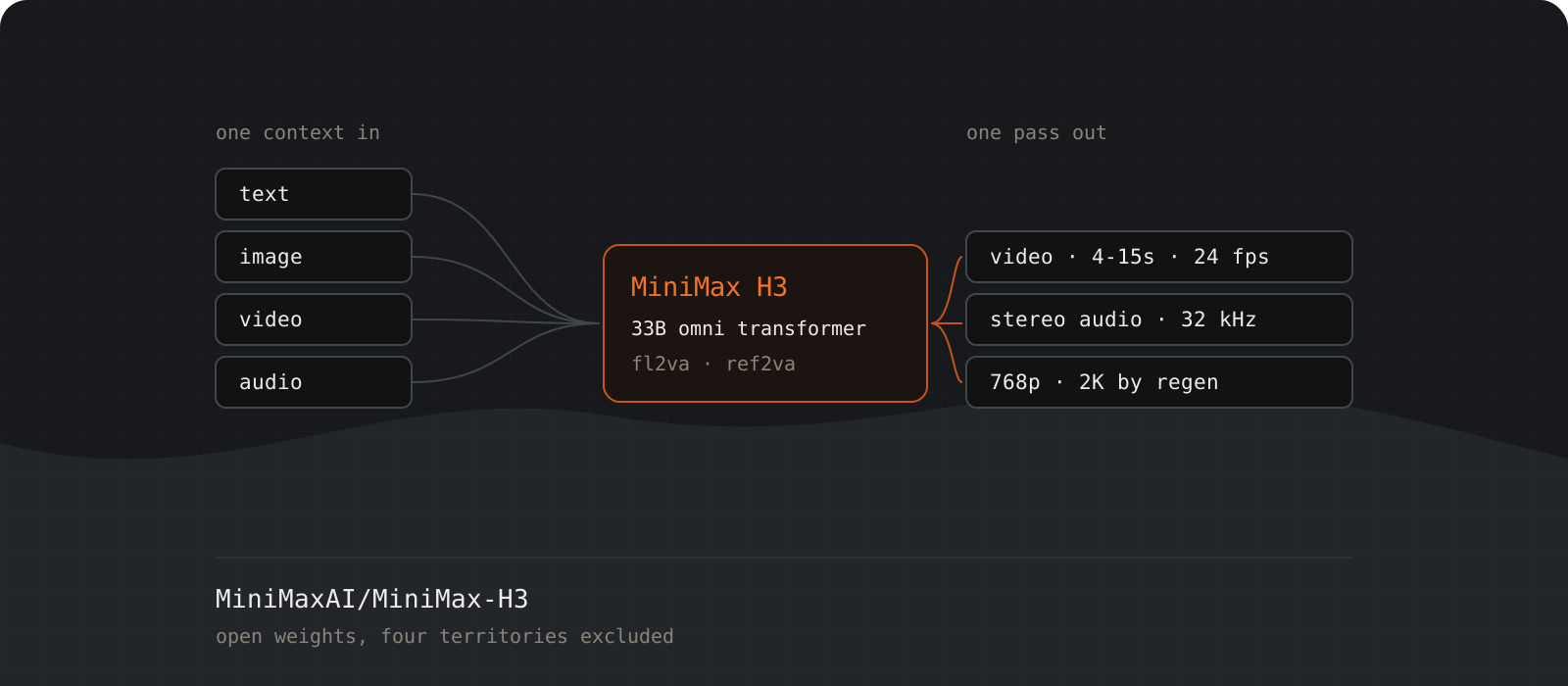
MiniMax H3 is a general-purpose multimodal generation model that reads text, images, video, and audio as a single context and returns video with synchronized stereo audio in one pass. Clips run 4 to 15 seconds at 24 fps, 768p by default, with an optional regeneration step to 2K. MiniMax announced it on 31 July 2026 and published open weights on 3 August 2026. There are two ways in, and they are not equally available. The hosted API costs $0.08 per generated second at 768p and $0.13 at 2K. The 33B open checkpoints are a free download, but their license excludes the United States, the European Union, the United Kingdom, and the Republic of Korea from local deployment. That clause decides which half of this guide applies to you, so read it before you shop for a GPU.
System requirements
Fastest path
A MiniMax platform account
The hosted API and the Hailuo web app need no GPU and no install. You pay per second of finished video, so a first test costs cents instead of a weekend.
License territory
Open weights are off limits in four regions
The MiniMax H3 Community License names the European Union, the United Kingdom, the Republic of Korea, and the United States of America as Excluded Territories. The hosted API is a separate service under MiniMax's platform terms.
Local GPU
24 GB VRAM as a practical floor
MiniMax's reference deployment uses four GPUs under SGLang. Quantized ComfyUI builds are much smaller: ComfyUI reports the stack dropping from 123.6 GB in full precision to 42.5 GB, and community measurements put peak VRAM near 20 GB for the pruned INT8 checkpoint. Treat 24 GB as a recommendation, not a published vendor minimum.
Disk
About 45 GB for the quantized set
You need the diffusion model, a Qwen3-VL text encoder, and two VAEs for video and audio. FL2VA and Ref2VA are separate diffusion checkpoints, so keeping both roughly doubles the diffusion model on disk.
Software
ComfyUI 0.30.0 or later, or SGLang, vLLM, or diffusers
ComfyUI shipped day-zero templates for text-to-video, image-to-video, and reference-to-video. SGLang is MiniMax's recommended server path and comes with a cookbook.
Cost
$0.08 per second at 768p, $0.13 at 2K
Regenerating a finished 768p render up to 2K costs $0.05 per second. The first five reference images per task are free, then $0.04 each. Reference audio is free. Context-IR is billed as tokens at $0.90 per million in and $3.60 per million out.
Pick the door that matches your situation
Three ways to reach H3, and only two of them are open to everyone.
The Hailuo web app is the no-code option. Use it to judge whether H3's output quality suits your work before writing a line of integration code.
The hosted API is the production path. It exposes both generation modes plus two pieces that are not in the open release: H3-Context-IR, which turns a messy multimodal brief into a structured prompt, and H3-Regenerate-2K, which upscales a finished render.
The open weights are for people outside the Excluded Territories who want local control, custom fine-tunes, or offline batch work. Everything else in this guide still applies, but you will be capped at 768p because the 2K regeneration module is not open-sourced yet.
Tip
Read the license before you size a GPU. The territory clause rules out more readers than the VRAM number does.
Create an API key and generate one clip
A single POST creates a task and returns a task_id. Generation is asynchronous.
Create the key in the MiniMax platform console, then export it as an environment variable. Do not paste it into a notebook you plan to share.
The request body needs four things: model, a content array, a resolution of 768P or 2K, and a duration between 4 and 15 seconds. The ratio field is optional and defaults to adaptive.
Start at 768P and 5 seconds. That is 40 cents. It tells you whether your prompt reads the way you expect before you spend on length or resolution.
export MINIMAX_API_KEY="your-key-here"

curl -X POST https://api.minimax.io/v2/video_generation \
  -H "Authorization: Bearer $MINIMAX_API_KEY" \
  -H "Content-Type: application/json" \
  -d '{
    "model": "MiniMax-H3",
    "content": [
      { "type": "text", "text": "A rain-soaked Tokyo side street at night. The camera pushes slowly past a ramen counter; steam fogs the glass. We hear rain on the awning and the low clatter of bowls." }
    ],
    "resolution": "768P",
    "duration": 5,
    "ratio": "16:9"
}'$env:MINIMAX_API_KEY = "your-key-here"
$body = @{
model = "MiniMax-H3"
content = @(@{ type = "text"; text = "A rain-soaked Tokyo side street at night. The camera pushes slowly past a ramen counter; steam fogs the glass. We hear rain on the awning and the low clatter of bowls." })
resolution = "768P"
duration = 5
ratio = "16:9"
} | ConvertTo-Json -Depth 5
Invoke-RestMethod -Method Post -Uri "https://api.minimax.io/v2/video_generation" -Headers @{ Authorization = "Bearer $env:MINIMAX_API_KEY" } -ContentType "application/json" -Body $bodyTip
The prompt field accepts up to 7000 characters. Length is not the constraint, so describe the shot rather than stacking keywords.
Poll the task and collect the file
The create call returns only a task_id. Fetch the finished video from the query endpoint.
Query the same task_id until the status reports success. The response then carries the video URL, resolution, duration, and the usage figures you will be billed on.
For anything beyond a manual test, set callback_url on the create request instead. MiniMax posts the result to your endpoint and you stop burning requests on a polling loop.
Download the file promptly. Treat hosted result URLs as temporary and move keepers into your own storage.
curl https://api.minimax.io/v2/video_generation/YOUR_TASK_ID \
-H "Authorization: Bearer $MINIMAX_API_KEY"Invoke-RestMethod -Method Get -Uri "https://api.minimax.io/v2/video_generation/YOUR_TASK_ID" -Headers @{ Authorization = "Bearer $env:MINIMAX_API_KEY" }Choose frame control or reference control
One model ID, two mutually exclusive conditioning modes, selected by the role on each content item.
Frame control, called FL2VA in the open release, covers plain text-to-video plus first-frame and last-frame conditioning. Attach an image_url with role first_frame or last_frame, or both to interpolate between two stills.
Reference control, called Ref2VA, is for carrying a subject, a motion, or a voice into the new shot. It accepts up to 9 images with role reference_image, 3 video clips of 2 to 15 seconds each with role reference_video, and 3 audio clips with role reference_audio, up to 12 files in total.
The two modes cannot be mixed in one request. A body carrying both first_frame and reference_image is rejected, which is also why the open release ships two separate checkpoints instead of one.
"content": [
  {
    "type": "text",
    "text": "The woman from the reference photo walks through the market, matching the camera move in the reference clip."
  },
  {
    "type": "image_url",
    "role": "reference_image",
    "image_url": "https://example.com/subject.jpg"
  },
  {
    "type": "video_url",
    "role": "reference_video",
    "video_url": "https://example.com/camera-move.mp4"
  }
]
Tip
Reference video is billed by its input duration at your output resolution rate, so a 15-second reference clip is not free context. Trim references to the part that matters.
Write the prompt as a scene, not a keyword list
H3 was trained on language that describes relationships between what is seen and what is heard.
MiniMax's stated design goal is that creators describe intent in natural language rather than entering a short visual prompt. In practice that means writing three things: what is in frame, what the camera does, and what the audio track contains.
Name the audio explicitly. H3 generates picture and stereo sound in the same pass, so leaving sound unspecified hands the model a free choice you may not want.
If your brief is a pile of references rather than a sentence, send it to the H3-Context-IR endpoint first. It reads the multimodal context and returns an enhanced prompt at content.prompt, which you then pass to the generation endpoint. It is billed as tokens, not seconds, and it creates no video by itself.
Interior, a small print workshop at dusk.
A man in an ink-stained apron pulls a poster off the press and holds it to the window light.
Camera: slow dolly in, ending on a medium close-up of the poster.
The poster reads AGENT BUILDERS HQ in heavy condensed type.
Audio: the rhythmic clack of the press, paper rustle, faint street noise through the glass. No music.
Tip
Accurate text and brand rendering is one of the things MiniMax reports H3 handling well. Spell out the exact string you want on screen, in capitals if that is how it should appear.
Draft at 768P, upgrade only the takes you keep
768P plus regeneration costs the same per second as direct 2K, but you only pay the upgrade on winners.
Direct 2K is $0.13 per second on every attempt, including the ones you throw away. Drafting at 768P costs $0.08 per second, and regenerating a keeper to 2K adds $0.05 per second.
Ten rejected 5-second drafts plus one 2K upgrade comes to roughly $4.25. Eleven attempts straight at 2K comes to $7.15. The gap widens with every extra take.
Regeneration is not a conventional upscaler. MiniMax runs the base model again over the original multimodal context, which is how small on-screen text can come back sharper instead of merely larger. It also means input materials are re-billed at reduced rates: the first five images stay free, then $0.025 each, and the source video is charged at $0.05 per second.
Run the weights locally, where the license allows it
ComfyUI is the shortest local route. SGLang is the one MiniMax documents for serving.
Confirm your jurisdiction first. The Community License permits use only inside the Applicable Territory, and the Excluded Territories are the EU, the UK, the Republic of Korea, and the USA. MiniMax publishes an application form for organisations in those regions.
For ComfyUI, update to 0.30.0 or later and load one of the three shipped templates: video_minimax_h3_t2v.json, video_minimax_h3_i2v.json, or video_minimax_h3_r2v.json. The text-to-video and image-to-video templates use the fl2va diffusion model; reference-to-video uses ref2va.
For a server, MiniMax's SGLang example runs across four GPUs with Ulysses parallelism. vLLM and diffusers recipes are in the repository as well.
Two things stay behind the API. H3-Context-IR is not open-sourced, so you supply your own prompt preprocessing or follow MiniMax's prompting guidance. H3-Regenerate-2K is not open-sourced either, so a fully local pipeline currently tops out at 768p.
pip install -U "huggingface_hub[cli]"

hf download MiniMaxAI/MiniMax-H3 \
  --include "model_index.json" "FL2VA/*" "Ref2VA/*" \
--local-dir MiniMax-H3npx skills add https://github.com/MiniMax-AI/MiniMax-H3 --skill h3-prompt-writingTip
The ComfyUI weights are quantized repackages hosted under Comfy-Org/MiniMax-H3, not the BF16 originals. Expect a quality trade against API output, and take filenames from the workflow notes rather than guessing.
What is MiniMax H3?
MiniMax H3 is a video model that treats text, images, video, and audio as one input space instead of a set of separate tasks. Where a typical stack has one model for text-to-video, another for image-to-video, a third for subject reference, and a separate pass for sound, H3 folds those into a single generation step and lets you describe the relationships between them in plain language.
The most visible consequence is audio. H3 produces 32 kHz stereo alongside the picture in the same pass, covering dialogue, effects, and ambience together, rather than generating silent video and scoring it afterwards. Output runs 4 to 15 seconds at 24 fps in six aspect ratios from 21:9 to 9:16.
It is also the model behind Hailuo. If you have used the Hailuo web app since early August 2026, you have already used H3 without seeing the model name.
What is open, and what stays behind the API
| Open weights (3 August 2026) | Hosted API only |
|---|---|
| H3-Base FL2VA, the text and frame-conditioned checkpoint | H3-Context-IR, the multimodal prompt interpreter |
| H3-Base Ref2VA, the reference-conditioned checkpoint | H3-Regenerate-2K, the in-context upscaling module |
| Processor, tokenizer, Qwen3-VL text encoder, and video and audio VAEs, in BF16 | Managed serving, the task queue, and callbacks |
| 768p ceiling without the regeneration module | 768P and 2K, priced per generated second |
| Free to download, restricted by territory and revenue | Available wherever MiniMax serves the platform |
What does MiniMax H3 cost?
- Generation: $0.08 per second at 768P, $0.13 per second at 2K. A 5-second 2K clip is $0.65; a 15-second 2K clip is $1.95.
- Regeneration from 768P to 2K: $0.05 per second of upgraded output.
- Reference images: the first five in a task are free, then $0.04 each. Under regeneration the extra images drop to $0.025.
- Reference video: billed by input duration at your output rate, so $0.13 per second when generating at 2K.
- Reference audio: free.
- H3-Context-IR: $0.90 per million input tokens and $3.60 per million output tokens. MiniMax describes it as distilling roughly 100K tokens of inference down to about 4K tokens on average.
- Open weights: no license fee. Your cost is GPU time, storage, and the engineer running it.
Can I legally run the open weights?
If you are in the United States, the European Union, the United Kingdom, or the Republic of Korea, then no, not by default. The MiniMax H3 Community License defines those four as Excluded Territories and states that you may not use, reproduce, modify, distribute, or display the works or their outputs outside the Applicable Territory. MiniMax publishes an application form for organisations in those regions, which is a route to ask for an exception rather than an automatic grant.
Two further conditions apply wherever you are. Commercial products or services earning more than 20 million US dollars in yearly revenue need separate prior written authorization from MiniMax, and any commercial product built on H3 must display the MiniMax H3 name in its interface. The license also forbids using H3 or its outputs to improve any other AI model that is not H3 or a derivative of it.
None of this touches the hosted API or the Hailuo apps. Those are services governed by MiniMax's platform terms, not by the weights license, so the territory restriction is specifically about running the model on your own hardware. Check the current license text yourself before shipping anything commercial. This is a summary written on 19 August 2026, not legal advice.
What hardware do I need to run it locally?
MiniMax has not published a single-GPU minimum. Its documented reference is a four-GPU SGLang deployment, which tells you what the team optimises for rather than where the floor is.
The practical numbers come from the quantized ecosystem. ComfyUI reports the full stack shrinking from 123.6 GB in full precision to 42.5 GB using the smallest variants, and community measurements of the pruned INT8 checkpoint put peak VRAM near 20 GB. Our read: 24 GB is the sensible target for a comfortable local run, 16 GB is workable with offloading and patience, and anything smaller is an experiment rather than a workflow. Those are practical recommendations, not vendor requirements.
How H3 is built
- H3-Omni-Transformer: a 33B single-stream dense transformer with modality-specific AdaLN, three-dimensional multimodal rotary position embeddings, and sparse attention support. About 13B of the parameters sit in AdaLN branches that can be cached at inference. MiniMax says separating understanding and generation workloads improved training throughput by roughly 30 percent.
- H3-Contextual Omni Representation: the captioning layer that describes relationships across modalities and across shots, using language as the bridge between them. This is the idea the shipped Context-IR endpoint implements.
- H3-VAE: a rebuilt tokenizer that MiniMax credits with a 4x gain in effective sequence length, which is what makes native 2K practical rather than merely possible.
- In-context regeneration: instead of a dedicated super-resolution network, the base model regenerates the low-resolution output while looking at the original context. That is why it can recover small text a conventional upscaler would only blur more confidently.
The trade-offs worth knowing
- Fifteen seconds is a shot, not a scene. H3 does native multi-shot modelling inside a clip, but anything longer than a single beat still needs an edit timeline and a plan for continuity between generations.
- The open release is partial by design. Without Context-IR and Regenerate-2K, a local pipeline gives up both the prompt interpreter and the 2K path, which is a real gap against the hosted product.
- The license is more restrictive than Apache 2.0 or MIT, and the territory clause excludes a large share of the people who will read about it. Compare that against permissively licensed video models before you build a product on it.
- Per-second pricing is cheap per clip and expensive per project. Iteration is where the money goes, which is the whole argument for drafting at 768P.
- Generated stereo audio removes a step, and removes a control point with it. If you need a specific music bed or a licensed voice, you are still doing that in post.
- MiniMax's price comparison against mainstream models is the vendor's own framing, with no named competitors and no benchmark table in the launch post. Treat it as a claim to check against your own bill.
Who should use H3, and who should wait
- Use the API if you generate short-form video at volume and want picture and sound in one call. The per-second cost is low enough to test properly this week.
- Use the open weights if you are outside the Excluded Territories, have 24 GB of VRAM or a rented GPU, and want to fine-tune or batch offline.
- Wait if you need clips longer than 15 seconds, guaranteed shot-to-shot character consistency, or a permissive license you will not have to re-read before every commercial release.
- Do not plan a local 2K pipeline yet. MiniMax says the regeneration module will be released once it is ready, and that is not a date.
Our verdict
H3 is the most interesting open video release of the year so far, and the reason is the audio. Generating picture and synchronized stereo in one pass collapses a step most pipelines still handle separately, and doing it while accepting text, images, video, and audio as one context is a cleaner interface than a menu of task-specific endpoints.
What we would do: start on the hosted API, draft at 768P, and regenerate only the takes worth keeping. That is the version of H3 everyone can use, and per-second pricing makes a real evaluation cheap. Treat the open weights as a second decision, gated on where you are and whether you can live with a 768p ceiling until the regeneration module ships. If your work depends on a permissive license, H3 is worth watching rather than adopting.
Start on the API, draft at 768P, and regenerate only the keepers. The open weights are strong and sharply restricted, so check the territory clause before you plan around them.
Frequently asked questions
Is MiniMax H3 free?+
The weights are a free download under the MiniMax H3 Community License, but the hosted API is paid: $0.08 per generated second at 768P and $0.13 at 2K. Running the weights yourself has no license fee and still costs GPU time, storage, and setup effort.
Can I use MiniMax H3 in the United States or the EU?+
You can use the hosted API and the Hailuo apps, which are governed by MiniMax's platform terms. You cannot deploy the open weights locally by default: the license names the EU, the UK, the Republic of Korea, and the USA as Excluded Territories, and points organisations there to an application form.
How long can a MiniMax H3 video be?+
Four to 15 seconds per generation, at 24 fps, in aspect ratios from 21:9 to 9:16. H3 models multiple shots inside a single clip, but a longer piece means multiple generations assembled in an editor.
Does H3 really generate the audio, or is it added afterwards?+
It generates 32 kHz stereo in the same pass as the picture, covering dialogue, sound effects, and ambience together. That is why prompts should say what is heard as well as what is seen; leaving audio unspecified lets the model choose for you.
What is the difference between FL2VA and Ref2VA?+
FL2VA handles text-to-video plus first-frame and last-frame conditioning. Ref2VA handles reference-driven generation, accepting up to 9 images, 3 video clips, and 3 audio clips as references. They are separate checkpoints in the open release and mutually exclusive modes in a single API request.
Do I need a GPU to use MiniMax H3?+
Not for the API or the Hailuo web app, which run on MiniMax's hardware. For local inference, plan on 24 GB of VRAM with a quantized build. MiniMax's own reference deployment uses four GPUs under SGLang.
Is MiniMax H3 the same thing as Hailuo?+
Hailuo is the consumer product and H3 is the model behind it. Using the Hailuo app is the fastest way to judge H3's output quality before you write any integration code.
Can I use H3 output commercially?+
Yes within the license terms, with two conditions worth flagging. Products or services above 20 million US dollars in yearly revenue need separate written authorization from MiniMax, and commercial products must display the MiniMax H3 name in the interface. Read the current license text before you ship.